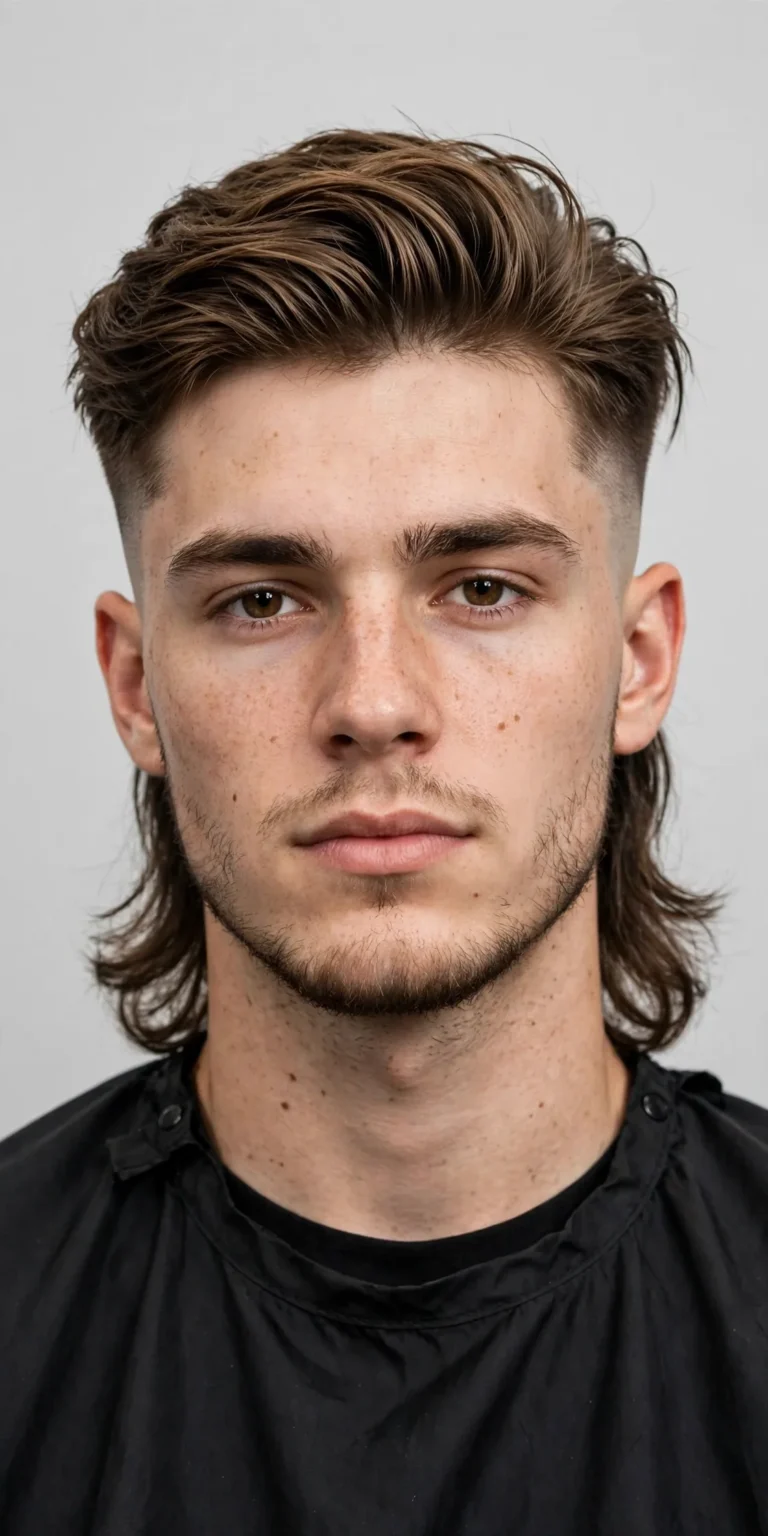
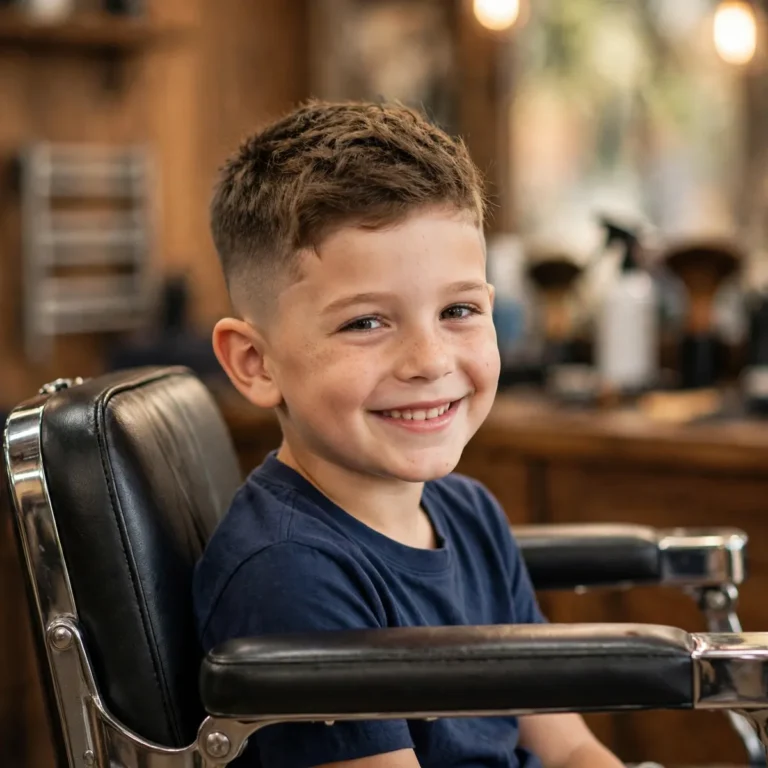
30 Best Side Part Haircuts for Men
Some haircuts come and go with the seasons. The side part haircut has never left. It showed up sharp on Wall Street a century ago, showed up again on every red carpet since, and today it is back in the chair — cleaner, more flexible, and paired with everything from soft tapers to skin fades. If you are hunting for the best side part haircuts for men, this guide walks you through 30 of them: classic and modern, sleek and textured, plus the honest answers no other guide gives you — which side to part on, how to handle a cowlick, what to say to your barber word for word, and which product actually matches your hair type.
Whether you call it a men’s side part, a side part hairstyle, or simply one of those timeless side part haircuts for men, the formula is the same: hair that is longer on top, swept to one side along a defined parting line, with shorter, neater sides. Below you will find 30 side swept styles for every hair type and face shape — each with styling notes and an exact barber script — plus a step-by-step styling routine, a product matrix, and answers to the questions guys really ask.

What Is a Side Part Haircut?
A side part haircut is any men’s haircut where the top is grown out long enough to sweep to one side along a parting line that sits off-center on the head. The part can be natural — the place your hair wants to fall on its own — or hard (also called a razor part), where the barber shaves a thin, crisp line exactly where the part sits. Both are side parts. The natural version is softer and more forgiving as it grows; the hard version is sharper and more graphic but needs upkeep.
The sides can be anything: scissor-tapered for a traditional look, blended with a fade haircut, disconnected with an undercut, or left classic and combed. That versatility is the whole point. The part is the star of the show, and the sides are its supporting cast — you get to choose how dramatic that cast is.
Length matters. You need roughly two to five inches on top for most side part hairstyles: less than two inches and there is nothing to sweep; more than five and gravity starts fighting the part. The sweet spot for a first-timer is about three inches on top with sides that are short enough to contrast. If you are coming from a short buzz or a long fringe, ask your barber how many trims the top needs before you are ready — growing into a side part is a two- or three-cut process, not one.
Classic & Timeless Side Part Haircuts
The styles below are the foundation of the side part family. They have survived every trend cycle because they flatter almost every face and work in every setting — boardroom, wedding, first date, job interview. If you are new to the men’s side part, start here.
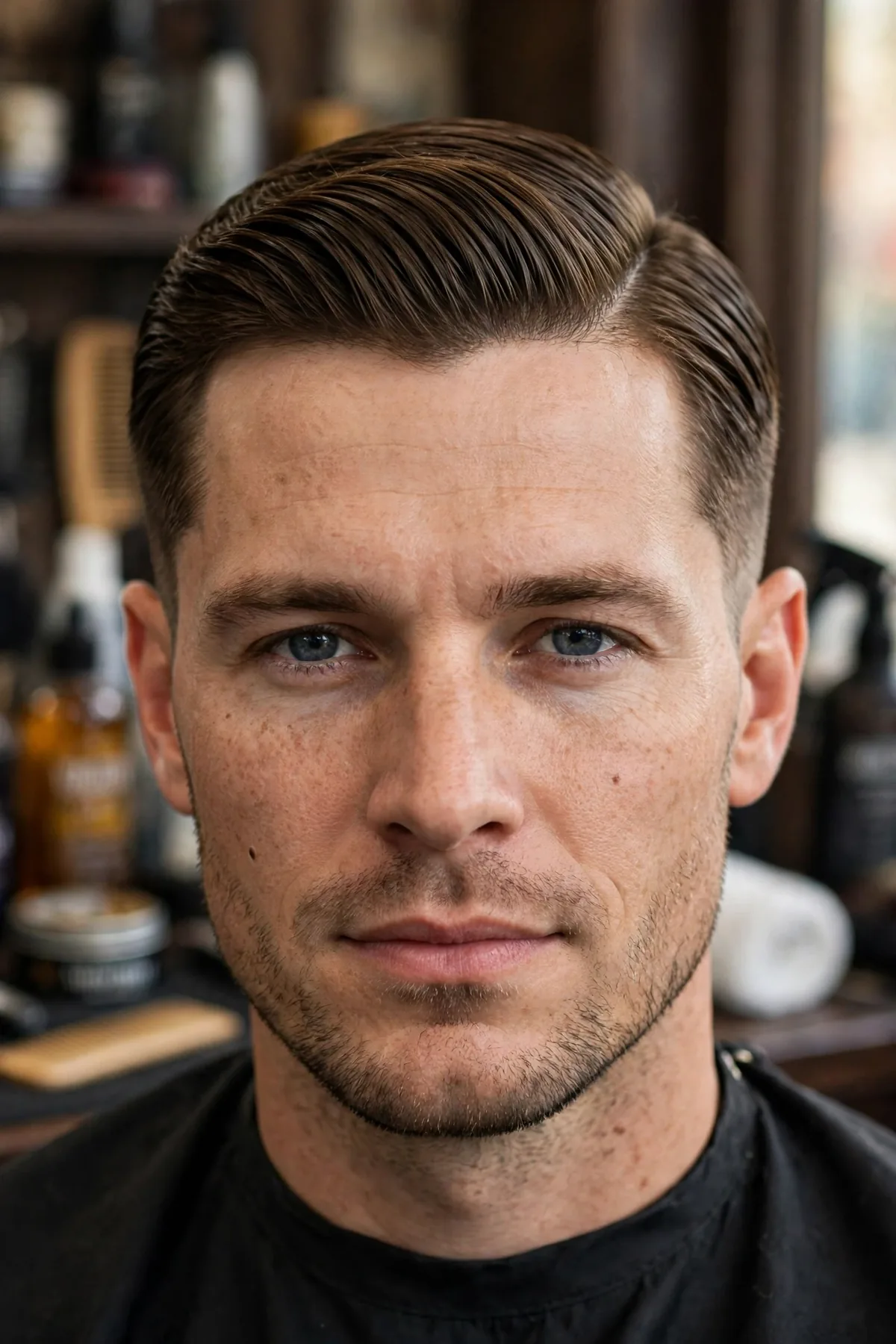
1. Classic Side Part
The classic side part is the original: a soft natural part, hair swept smoothly to the side, and sides that are neatly tapered with scissors. No fade, no hard line, no drama — just a clean, confident silhouette that looks as good at 25 as it does at 65. It suits straight to slightly wavy hair best, and it flatters oval, square, and oblong faces especially well because the diagonal sweep breaks up the face’s symmetry just enough to look interesting. This is the style to pick when you want to look polished without looking like you tried too hard.
Ask your barber: “Natural side part, three inches on top swept to the side, scissor-tapered sides, no fade — keep it traditional.”
Style it: Work a dab of classic pomade through damp hair, comb the part line in first, then sweep the top over.
2. Side Part Ivy League
The Ivy League is the side part’s athletic younger brother: everything the classic is, just shorter and more practical. The top is about an inch and a half to two inches — long enough to part and sweep, short enough to style in ninety seconds. It is the cut college guys and busy professionals live in because it survives a hat, a workout, and a nap without collapsing. Oval and heart-shaped faces wear it particularly well. If you like the classic but want less maintenance, this is your lane.
Ask your barber: “Ivy League with a side part — about two inches on top, tapered sides, short enough to finger-style.”
Style it: Towel-dry, push a fingertip of matte paste through the top, and sweep to your natural part. Done.

3. Slicked-Back Side Part
The slicked-back side part takes the sweep and runs it farther back — the hair still parts on one side, but the flow goes back and over instead of straight sideways. It reads more formal and more vintage than the classic, the kind of style that pairs with a suit and a strong brow game. You will need three to four inches on top and a product with shine and real hold. It works beautifully on thick, straight hair; fine hair can get there too but needs a blow-dryer first to build body.
Ask your barber: “Three to four inches on top for a slicked-back side part, tapered sides, textured enough to comb back with flow.”
Style it: Blow-dry up and back with a brush, then comb in a high-shine pomade following your part line.

4. Side Part Comb Over
The comb over is simply a side part with commitment: longer hair on top, combed firmly over to one side from a low, defined parting. It gets an unfair rap from the old baldness-camouflage jokes, but done right — with real length on top and clean sides — it is one of the most flattering side part hairstyles a guy can wear. It covers a wide forehead naturally and adds perceived density. Pair it with a taper rather than a hard fade for the most modern take. If you want the full breakdown, see our comb over haircut guide.
Ask your barber: “Long comb-over side part — four inches on top swept from a defined part, tapered sides, clean edges.”
Style it: Part while damp, comb the top over in one direction, and lock it with a medium-hold cream.
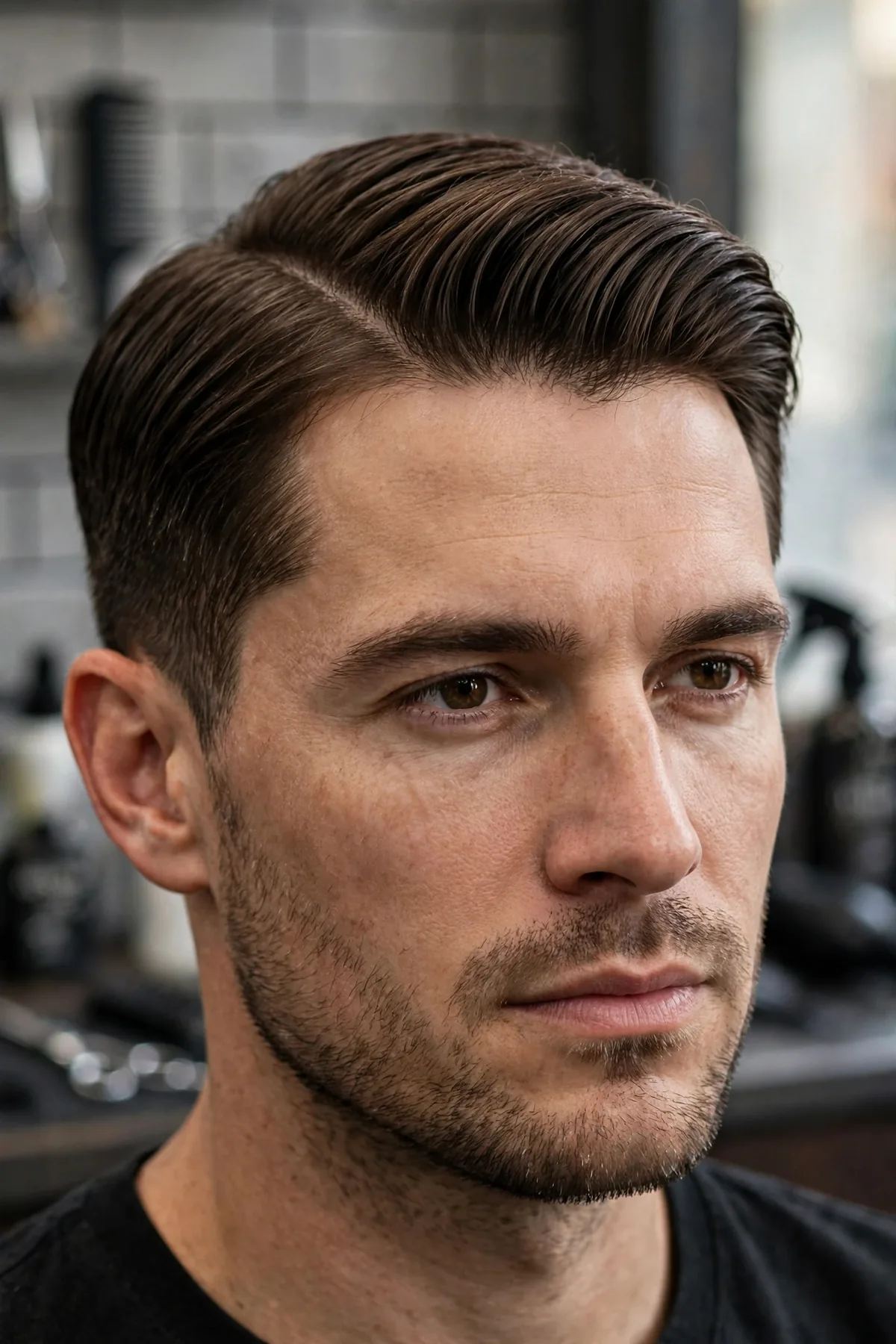
5. Textured Side Part
The textured side part is the modern answer to the classic: same part, same sweep, but the top is point-cut into choppy layers so it breaks apart naturally instead of lying flat. It reads younger, more casual, and more current — the side swept look that dominates barbershop feeds right now. It is also the most forgiving option on the list because the texture hides imperfections: bad part day? Rough it up and it looks intentional. Straight, wavy, and fine hair all take to it well. Our textured crop haircut guide covers the choppy cutting technique in depth.
Ask your barber: “Side part with a textured top — point-cut about three inches on top, messy but controlled, tapered sides.”
Style it: Rough-dry with your fingers, then scrunch a pea of matte clay through the ends.

Modern Fades & Tapers
This is where the old-school part meets the new-school barbershop. Blending a side part into a fade or taper keeps the top refined while the sides carry all the modern edge. More contrast, more definition, and a much easier grow-out than a faded top with faded sides.
6. Side Part with Taper Fade
The side part with a taper fade is the most balanced modern option: the fade stays low and concentrated around the ears and neckline while the sides keep their length, so the top’s elegant sweep stays the focus. It grows out more gracefully than any true fade on this list — the blend just softens instead of looking ragged. If you want modern without going bold, this is the default recommendation. Our full taper fade haircut guide breaks down every height and top pairing.
Ask your barber: “Side part on top, low taper fade at the ears and neckline, keep the sides at a number 2 or 3.”
Style it: Style the top normally; the taper needs no product — just keep the edges cleaned up between cuts.

7. Side Part with Low Fade
A low fade starts the blend just above the ears, which keeps the overall silhouette soft while adding crisp definition at the perimeter. Paired with a side part, it looks like the classic haircut of a guy who also knows what a barbershop line-up is. It is the safest fade pairing on this list — conservative enough for strict dress codes, modern enough to look current. Round and oval faces do especially well with it since the low fade keeps width at the temples.
Ask your barber: “Side part, low fade starting just above the ears, number 2 down to a 1, three inches on top.”
Style it: Comb the part in damp hair, then finger-sweep the top over with a light cream.

8. Side Part with Mid Fade
The mid fade climbs to temple level, and that extra inch of blend gives the side part a sharper, more deliberate look. The contrast between the faded sides and the swept top is strong enough to photograph well and hold up on camera, which is why it is the go-to for guys who want their cut to read from across the room. It suits square and diamond faces nicely, since the mid blend shortens the appearance of a long side. Expect touch-ups every two to three weeks to keep the line crisp.
Ask your barber: “Side part with a mid fade — blend from a number 1 at the temple, three to four inches swept on top.”
Style it: Blow-dry the top over to one side for volume, then set the part with matte paste.
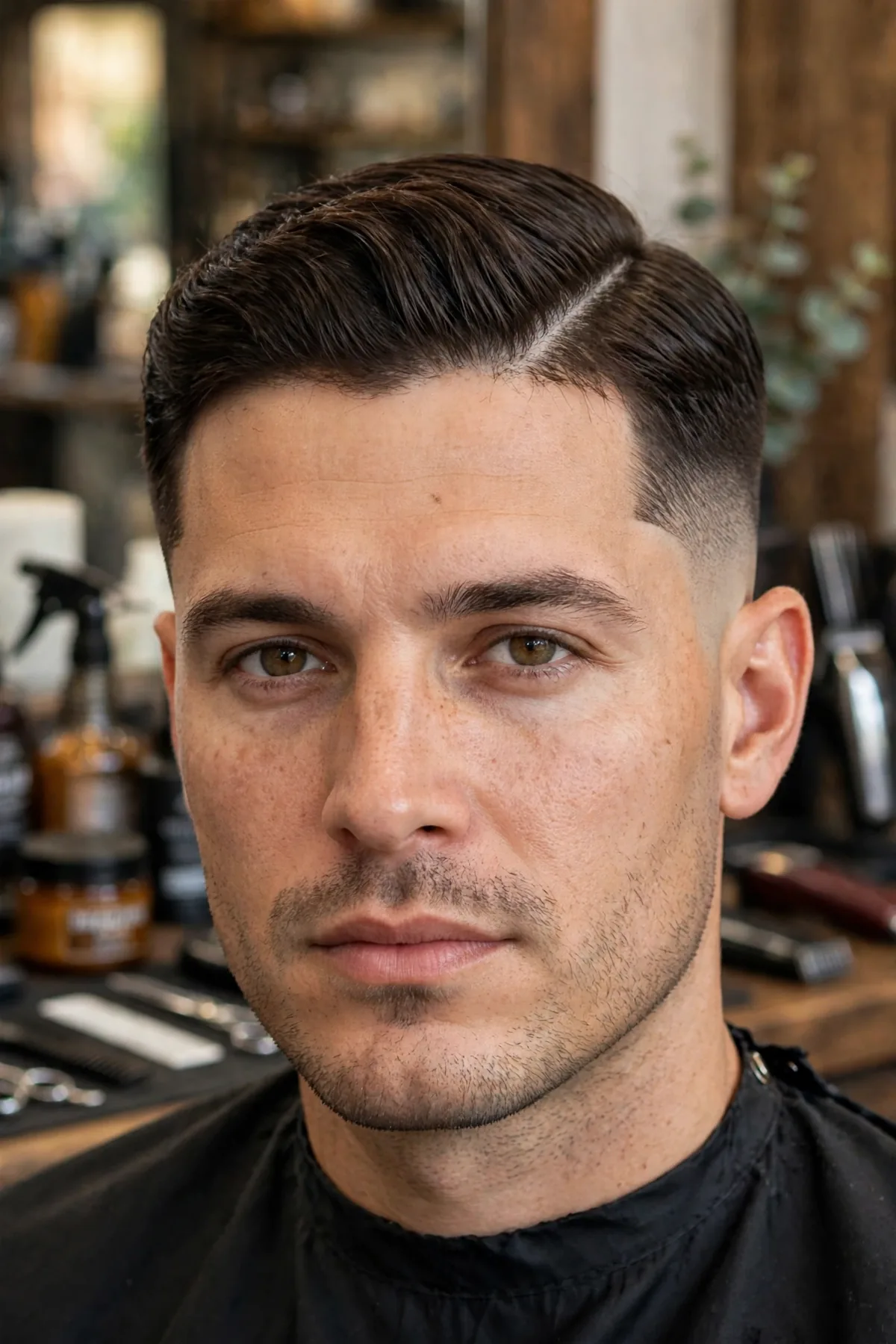
9. Side Part with High Fade
The high fade takes the blend a couple of inches above the ears, creating maximum contrast with the swept top. It is bold, it is modern, and it makes the part itself look razor-sharp by comparison — which is exactly why guys with thick, heavy hair love it. The downside is honest: a high fade shows growth fast and looks rough by week three, so budget for more frequent cuts. Best on straight to wavy hair with plenty of density up top.
Ask your barber: “High fade side part — fade up to two inches above the ears, number 0 or 1 at the shortest, heavy top swept to the side.”
Style it: The top needs hold — a strong pomade combed along the part keeps it from puffing over the fade.
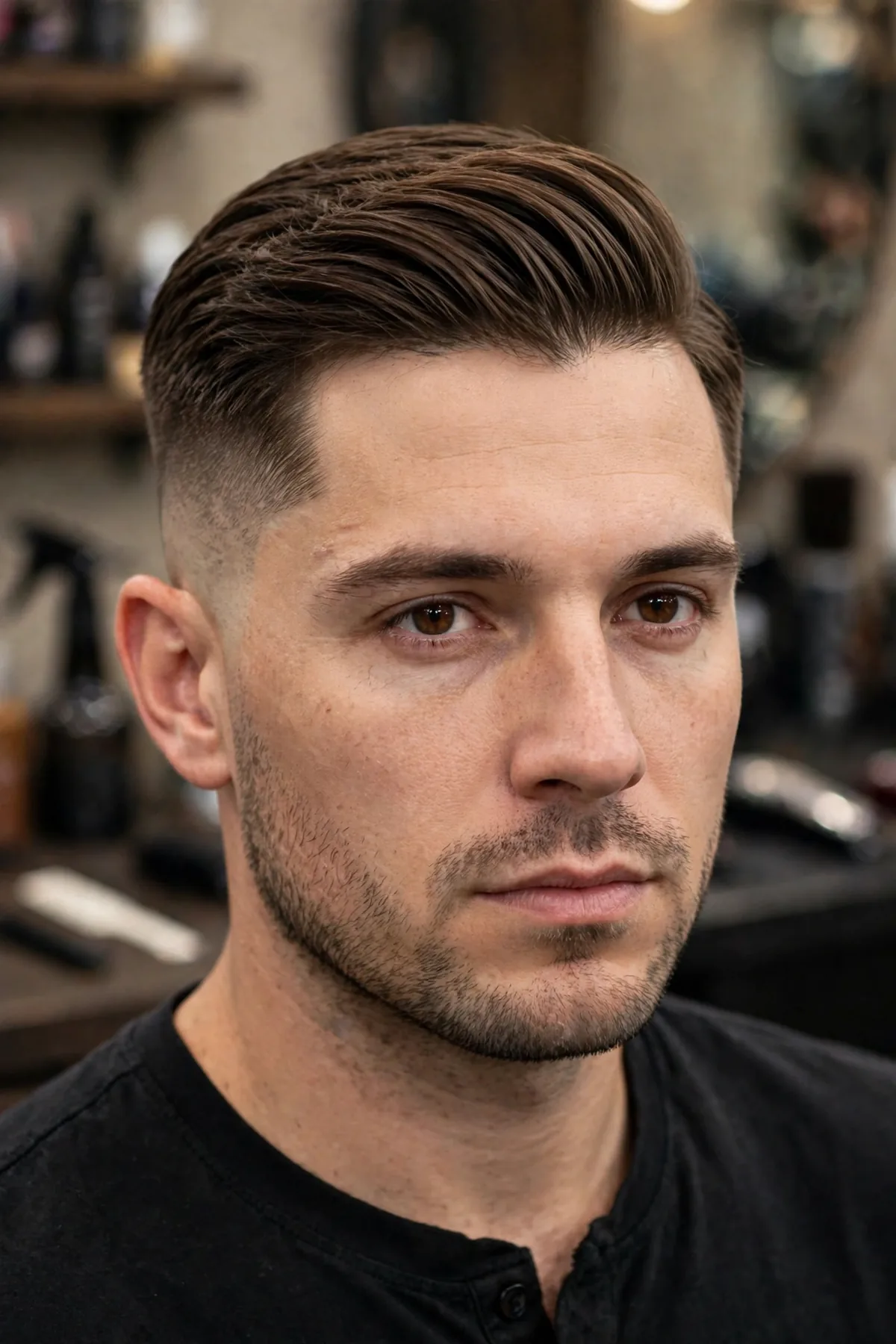
10. Side Part with Skin Fade
A skin fade (bald fade) takes the sides all the way down to bare skin, so the side part floats above completely clean sides. It is the most striking version of the modern men’s side part — the part line pops, the top looks thicker by contrast, and the whole cut has a crisp, almost editorial quality. It is also the highest-maintenance option here: the skin portion needs an edge-up every week or two. Great for guys who live at the barbershop, less great for guys who cut every two months.
Ask your barber: “Side part with a skin fade — bald at the bottom, blended up to a number 2, defined top swept to the side.”
Style it: Keep the skin portion moisturized and the top swept tight; a shine pomade makes the contrast look deliberate.

Bold & Edgy Side Part Haircuts
If the classic side part is a handshake, these are a fist bump. Sharp lines, disconnected lengths, and carved-in definition — this group takes the part from polite to powerful while staying firmly inside the side part family.
11. Side Part with Undercut
The side part undercut disconnects the top from the sides entirely: the top stays long and sweeps over while the sides are cut short to one even length underneath, creating a visible ledge where they meet. It is dramatic, it is unapologetic, and it turns the part into a design element. The contrast also makes thin hair on top look thicker. Fair warning: the grow-out phase is awkward, since disconnected lengths blend at different rates — commit to regular cuts or pick a taper instead. See our undercut haircut guide for the full playbook.
Ask your barber: “Side part undercut — disconnected, sides at a number 2 one length, four inches on top swept over the ledge.”
Style it: Push the top firmly across the disconnect with a strong-hold matte product; the ledge must stay covered.

12. Disconnected Side Part
Not every disconnect is an undercut. The disconnected side part can pair a swept top with longer, scissor-cut sides — no clippers required — where the top and sides simply do not blend into each other. It has the edge of the undercut without the buzzed-sides commitment, and it grows out more gracefully. Think of it as the undercut’s softer, more office-friendly cousin. It works on straight, wavy, and thick hair, and it gives fine hair the illusion of real density on top.
Ask your barber: “Disconnected side part — long swept top, scissor-cut sides left separate, no blending between them.”
Style it: Sweep the top across the disconnection line with a medium-hold cream so the break stays visible but clean.
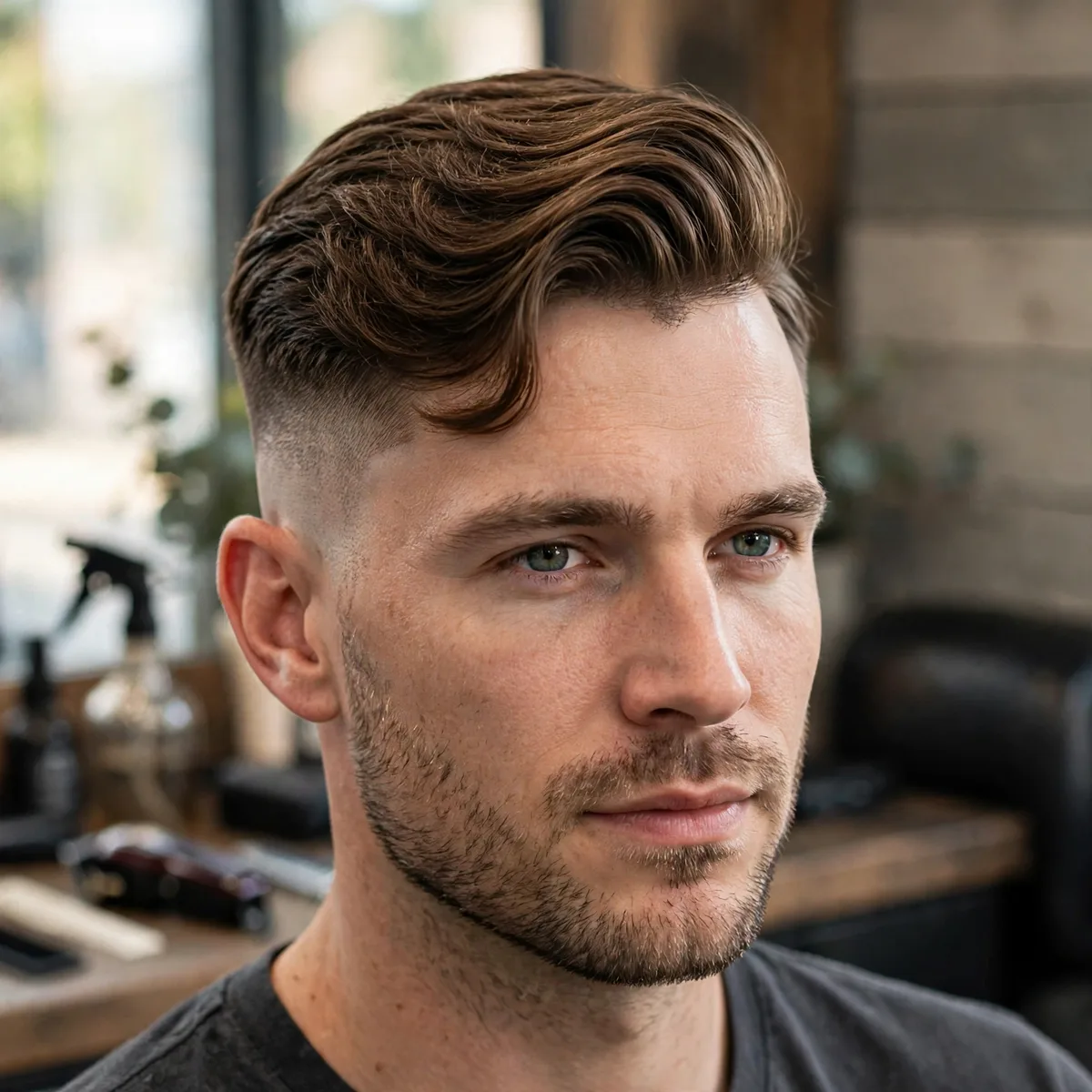
13. Hard Side Part
A hard side part is shaved in with a razor or trimmer, carving a thin, pale line exactly where the part sits. It makes the parting unmistakable and adds instant structure — even a slightly sloppy morning sweep looks deliberate because the line does the talking. The trade-off is maintenance: the shaved line starts to blur within a week and looks fuzzy by week two, so you will either be back in the chair often or learning to touch it up at home. More on that in the grow-out section below.
Ask your barber: “Side part with a hard part — shave the part line in, three inches on top swept over it, clean sides.”
Style it: Comb everything away from the shaved line so it stays visible; a shine product makes it pop.

14. Side Part with Design
Hair design — a carved line, a parallel slash, a geometric accent behind the part — turns the side part into art. The part line becomes the anchor for a design that runs along the temple or into the fade, and the effect is pure barbershop culture. It is temporary by nature (designs grow out in two to three weeks), which makes it perfect for events, vacations, or just a season of feeling bold. Bring reference photos, because “a line design” means different things to different barbers.
Ask your barber: “Side part with a carved line design — one clean slash parallel to the part, mid fade, top swept over.”
Style it: Keep the top swept away from the design so the carving stays the visual focus.
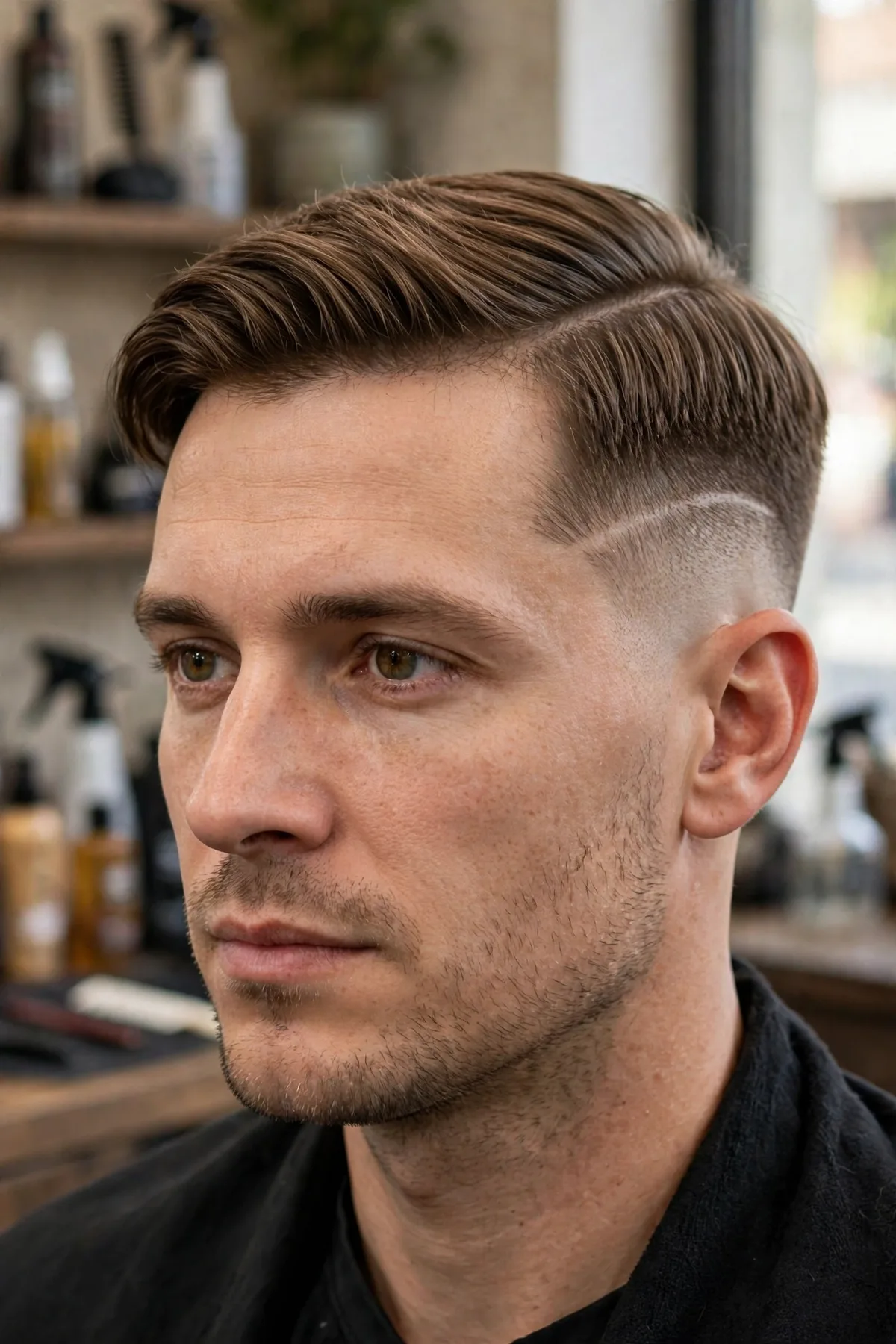
15. Side Part Pompadour
The side part pompadour merges two classics: the part gives the pomp its structure while the pomp gives the part its height. The top is swept up and over from the parting line rather than lying flat, creating that wave of volume pomps are famous for — just anchored on one side. It is a statement cut with vintage soul, and it photographs like nothing else. You will need four to five inches on top, a blow-dryer, and a product with serious hold. Our pompadour haircut guide covers the full styling ritual.
Ask your barber: “Side part pompadour — four to five inches on top swept up and over from the part, short sides.”
Style it: Blow-dry the top up and over with a round brush, then lock the wave with a strong-hold pomade.

Texture & Movement
A side part does not have to be sleek. The modern side part hairstyle often trades the comb for fingers — volume, flow, and a little chaos, all still anchored by that off-center parting.
16. Side Part with Quiff
The quiff takes the front of the side part and lifts it: the hair still parts to one side, but the front sweeps up and forward instead of lying flat. It adds height at the forehead, which is flattering for round faces and shorter foreheads, and it reads younger than the slicked-back version. The classic barber recipe is about three inches on top with the front left heaviest. See our quiff haircut guide for the blow-dry technique that makes it stand up.
Ask your barber: “Side part quiff — three inches on top, front lifted and swept to the side, tapered back and sides.”
Style it: Blow-dry the front up and over with a vent brush, then pinch the lift in place with matte clay.

17. Long Side Part
When the top grows past five or six inches, the side part becomes a flow haircut with a parting: hair sweeps across the head in one long, continuous motion. It is the most relaxed entry on this list — surfer energy, artist energy, weekend energy. The catch is weight: long hair pulls the part flat, so you need layers cut in to keep the sweep moving instead of hanging. A center-leaning part placement helps balance a long face. If you are growing it out, the messy middle months are real — hats and headbands are your friends.
Ask your barber: “Long side part — six inches on top swept to one side, layers for movement, sides trimmed to blend.”
Style it: Towel-dry, work a sea salt spray through, and let the sweep fall naturally — fight the urge to over-comb it.
18. Side Part with Fringe
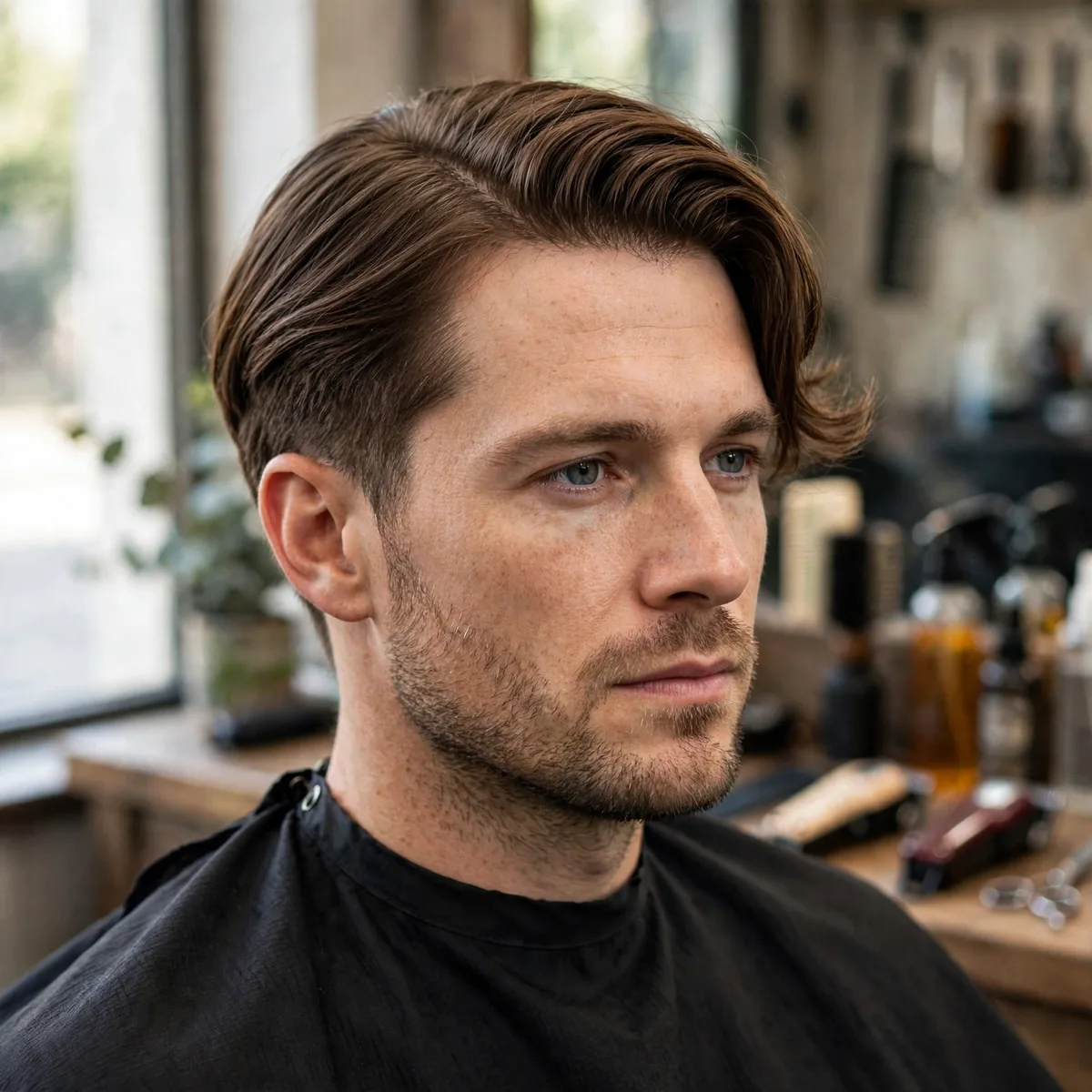
The side part with a fringe lets the front fall forward and to the side instead of sweeping flat: the parting is still there, but the hair breaks over the forehead in a soft, diagonal fringe. It is a great softener for a high forehead or a strong brow, and it reads younger than any sleek version on this list. The fringe should be textured at the ends so it does not look like a curtain. Straight and wavy hair take to it best; very curly hair needs the fringe cut longer to account for shrinkage.
Ask your barber: “Side part with a textured fringe — front falling forward and to the side, about three inches at the fringe.”
Style it: Push the fringe forward with your fingers while damp, then flick the ends sideways with a light cream.

19. Messy Side Part
The messy side part keeps the parting but lets everything else do what it wants: piecey, separated, slightly chaotic, like you styled it in thirty seconds — because you did. It is the lowest-effort style on this list and paradoxically one of the most flattering, since the looseness softens strong jawlines and the part keeps it from looking like bedhead. The secret is a point-cut top; without texture cut into the hair, “messy” just reads as “flat.” Our messy hairstyles for men guide has the full finger-styling playbook.
Ask your barber: “Messy side part — point-cut three inches on top for piecey texture, natural part, easy sides.”
Style it: Rough-dry upside down, then twist small sections with a dab of matte paste. Stop early — it should look unfinished.

20. Side Part with Blowout Volume
The blowout side part is volume-first: the top is blown up and over from the part so it sits tall and airy, with the sides kept tight for contrast. It is the haircut behind a thousand barbershop transformation videos, and the effect is real — a blow-dry adds a level of fullness no product alone can fake. It takes five to ten minutes each morning and a decent hairdryer, so it suits guys who genuinely enjoy the routine. Thick and wavy hair gets the most drama out of it; fine hair needs a pre-styling spray for grip.
Ask your barber: “Side part built for a blowout — four inches on top with layers, sides tight so the volume stands out.”
Style it: Blow-dry the top up and over from the part using a brush, finish with cool air, then set with a light clay.

Hair Type & Age
The side part is not a straight-hair-only club. These six versions adapt the part to curls, waves, thick and thin hair, receding hairlines, and the gray years — because the right side part haircut exists for every head of hair.
21. Curly Side Part
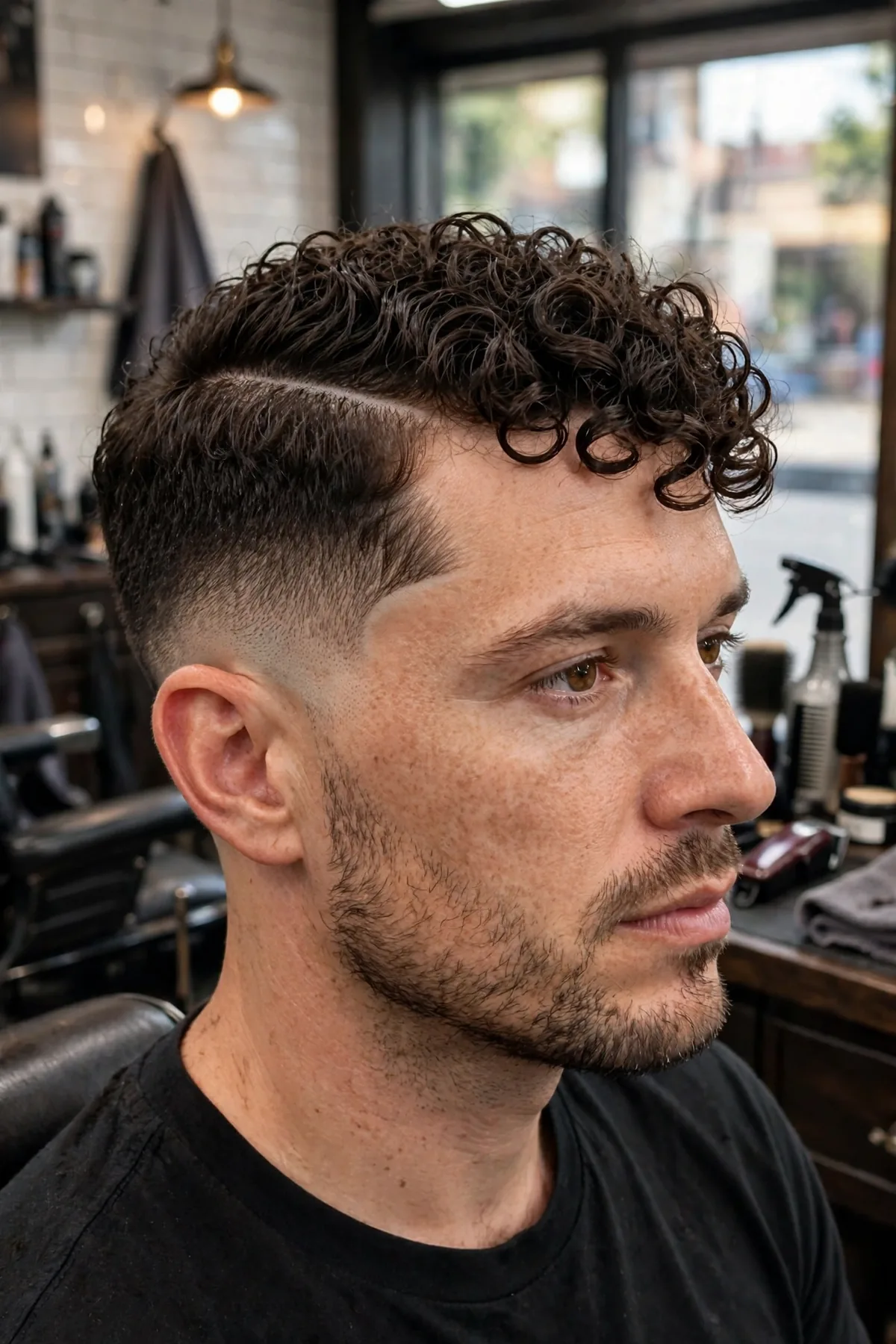
A curly side part lets the curls do the sweeping: the top is left long enough for curls to form and fall, and the part sits wherever the curl pattern opens most naturally. Forcing a part against a strong curl pattern is a losing battle, so work with the hair, not against it — find the line where the curls naturally separate and build the part there. Two to four inches of curl on top is the workable range. A curl cream on damp hair, scrunched upward, gives definition without crunch.
Ask your barber: “Curly side part — keep three inches of curl on top, find my natural part, tapered sides, dry-cut the curls.”
Style it: Scrunch curl cream into damp hair, arrange the part with your fingers, and let it air-dry or diffuse.
22. Wavy Side Part
Wavy hair might be the side part’s best friend: the natural bend gives the sweep built-in body, and the part has something to grip. The waves carry the style with almost no product — a sea salt spray is often the whole routine. Keep the top at three to four inches so the wave pattern has room to form; too short and the waves turn into bumps, too long and the part disappears under the weight. This is the version that looks best slightly imperfect, so resist the urge to over-style.
Ask your barber: “Wavy side part — three to four inches on top with layers for the wave, natural part, blended sides.”
Style it: Mist sea salt spray on damp hair, scrunch the sweep into place, and leave it alone while it dries.

23. Side Part with Spikes
Spikes and side parts sound like opposites, but the combo works: the top is cut short and textured so it spikes upward, while the whole mass still leans to one side along a part line. It is the side part’s punk-pop phase — energetic, youthful, and great for guys who want edge without a full faux hawk. The top only needs one and a half to two inches, so it is also one of the fastest-growing-in options here. A strong matte product is non-negotiable; spikes fall flat without grip.
Ask your barber: “Spiky side part — two inches of choppy texture on top, everything leaning to one side, faded sides.”
Style it: Work a strong matte clay through dry hair, pinch the ends upward, and angle the whole mass toward your part side.
24. Side Part for Thick Hair
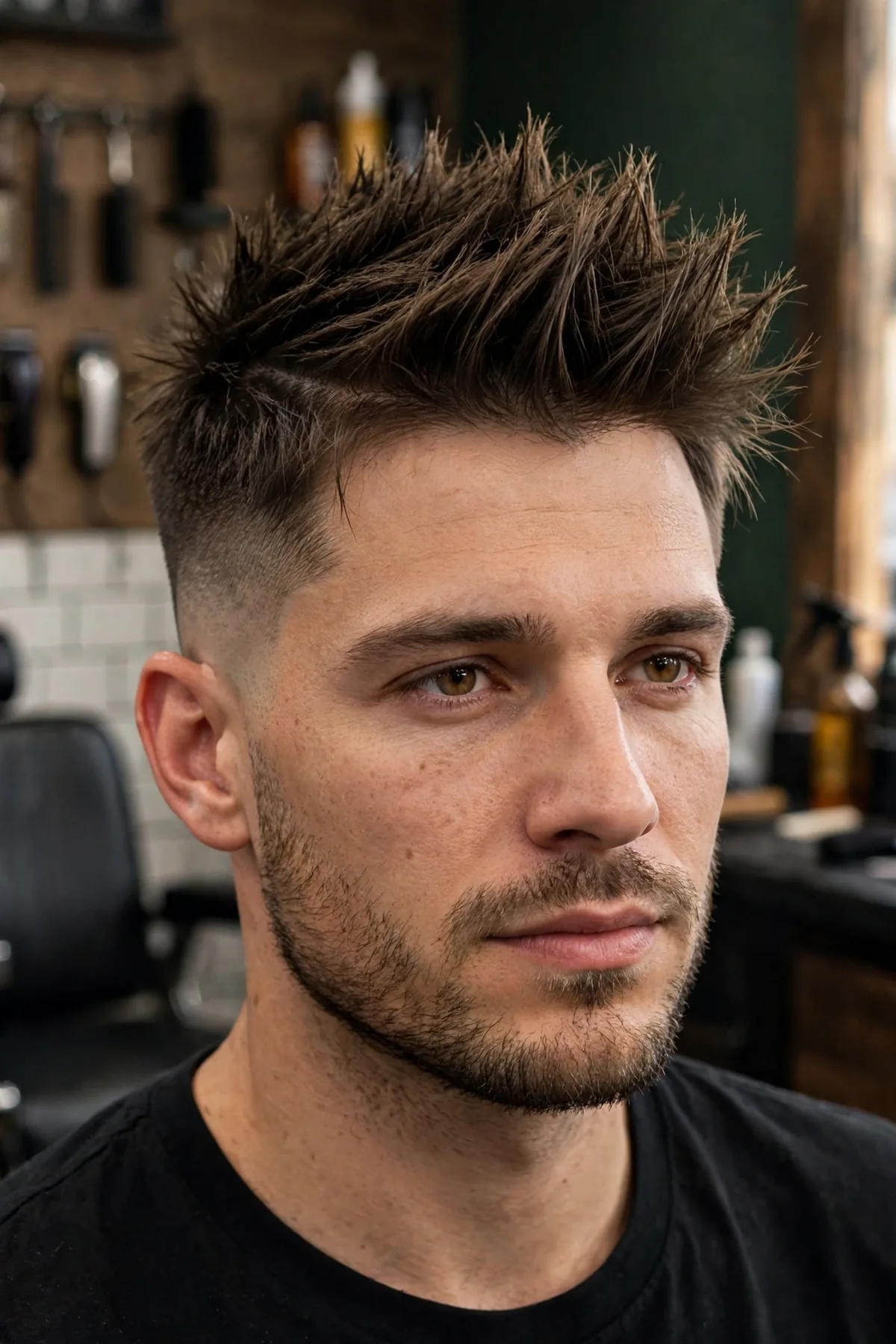
Thick hair and side parts are a power couple, but only with the right cut: unthinned thick hair sweeps into a wall that refuses to lie down. The fix is internal — thinning shears or deep point cutting to remove bulk while keeping length, so the sweep falls instead of puffing. Four inches on top with serious weight removal is the standard prescription, and the sides should be cut tight to keep the silhouette from going round. Skip heavy waxes; thick hair needs lightweight hold or it turns into a helmet.
Ask your barber: “Side part for thick hair — four inches on top, thin out the bulk underneath, tight sides, sweepable not puffy.”
Style it: Blow-dry the sweep flat against the head first, then add a light matte product to hold it.

25. Side Part for Thin Hair
Thin hair needs the side part’s best trick: the sweep itself creates the illusion of coverage by layering hair across the scalp. The rules are simple — keep the top short enough to stand (two to three inches), never comb it flat with heavy product, and let a little texture lift it. A matte product with no shine is essential, because shine shows scalp. Blow-drying the top against the part before sweeping builds volume thin hair cannot make on its own. Done right, a side part is one of the kindest cuts for thinning hair.
Ask your barber: “Side part for thin hair — two and a half inches on top, textured for lift, natural part, no heavy product.”
Style it: Blow-dry upward first for volume, then sweep over with a tiny amount of matte fiber. Less product, more hair.

26. Side Part for Receding Hairline
Here is the tactic no one spells out: when the temples are receding, move the part slightly toward the fuller side and let the top sweep forward-and-over rather than straight back — the diagonal sweep drapes hair across the corners instead of pulling away from them. A textured top with a soft, forward-leaning sweep hides recession better than any slicked style, and a hard part will expose thinning, so stick with a natural part. Keep the sides moderately short; buzzed sides next to a thin top draw the eye straight to the contrast. Confidence carries the rest — a well-kept side part reads intentional, not defensive.
Ask your barber: “Side part for a receding hairline — textured top swept forward and over, part on the fuller side, no hard part.”
Style it: Push the top forward first, then sweep diagonally across — never slick it straight back.

Special Situations
Coily hair, gray hair, crew-length hair, beards — the side part adapts to all of them. These four versions handle the situations the standard guides skip.
27. Side Part for Black Men
The side part works beautifully on coily and tight-curl hair — it just speaks a different language. On textured hair, the “part” is usually created with a defined line or a shaped wave pattern rather than a comb sweep: think a crisp part line carved into a low cut with waves, or a taper with the top brushed into a directional wave that breaks to one side. The essential barber terms are waves, a line-up, and a taper or low fade on the sides. Keep the top at wave length (short enough to lay down, long enough to pattern) and brush religiously — the part on coily hair is built by brushing, not by combing.
Ask your barber: “Side part with waves — defined part line, low taper, line-up sharp, top at wave length brushed to the side.”
Style it: Brush in the direction of the part daily with a wave brush and a light moisturizer; durag at night.

28. Side Part for Older Men
Gray hair and a side part were made for each other. The part gives silver hair structure it often lacks, and a softer finish — a natural part, a low taper instead of a skin fade, sides that keep a little length — reads distinguished rather than desperate. Two gray-specific tips: skip high-contrast fades, because pale skin against dark-faded sides next to silver on top looks harsh; and go lighter on product, because gray hair shows buildup fast. The classic side part or the Ivy League, kept neat and simple, is the mature man’s best look.
Ask your barber: “Classic side part for gray hair — natural part, low taper, keep the sides soft, easy to maintain.”
Style it: A small amount of light cream is enough; gray hair needs moisture, not hold.

29. Short Side Part
Crew length with a part: the top is kept at about an inch to an inch and a half — just long enough to show a parting line — with tight sides. It is the side part for guys who want the look without the morning routine: the part does the styling, and the whole thing takes a minute. It flatters strong jawlines and square faces, and it is the best entry point if you are nervous about longer hair. The part will be subtle at this length, which is the point — it reads as intention, not decoration.
Ask your barber: “Short side part — inch and a half on top with a visible part, tight tapered sides.”
Style it: A fingertip of paste, one pass with a comb along the part, done.
30. Side Part with Beard
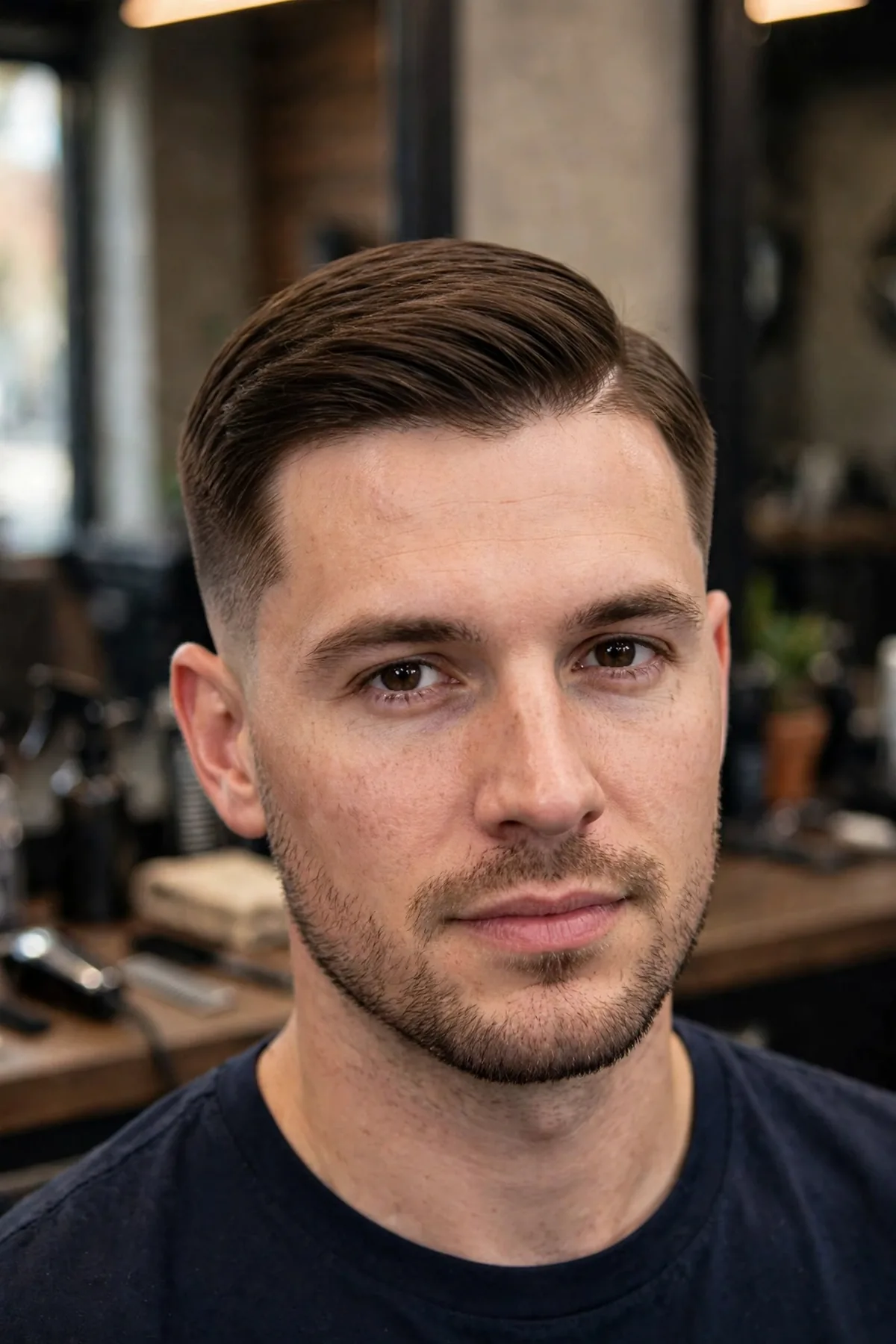
A side part and a beard are a natural pair — the neatness up top balances the ruggedness below. The key is the connection: the sideburns should blend into the beard’s cheek line with no gap, and the fade (if you have one) should flow into the beard fade rather than stopping at the ear. Keep the top polished and let the beard carry the texture, or vice versa — one structured element and one relaxed one is the formula. The beard’s neckline should be clean; a sharp neckline under a sharp part is the whole look.
Ask your barber: “Side part with the fade blended into my beard — connect the sideburns to the cheek line, clean beard neckline.”
Style it: Style the part as usual; keep the beard conditioned and the cheek line edged weekly.
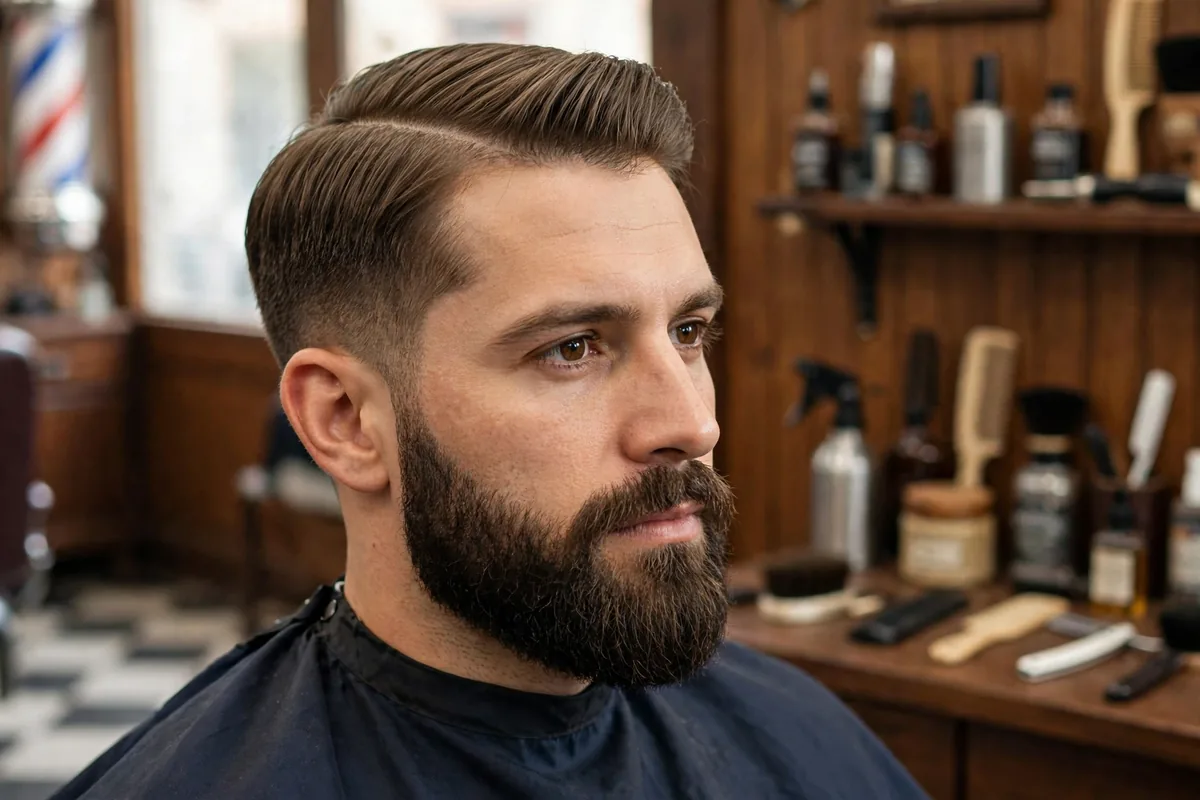
Which Side Should You Part On?
This is the most-asked side part question and the worst-answered one online. Here is a real method. First, find your natural part: let your hair dry with no product and no combing, then look at where it separates on its own — that is your hair’s vote, and it usually wins because it follows your growth pattern. Second, run the photo test: take a straight-on selfie with your hair parted on the left, then on the right, and compare. Most guys look better parting on the side opposite their dominant cowlick — the hair lies flatter and the sweep holds longer. Third, check your face: parting on the side of a stronger jaw or a scar can balance asymmetry, while a center-leaning part suits very symmetrical faces.
If your natural part is dead center, you get to choose — pick the side that matches your most natural cowlick fall. And if you want to switch sides, know this: hair has memory. It takes two to three weeks of consistent combing, plus blow-drying in the new direction while damp, to retrain a part. Be patient with it.
Cowlick Control: The Playbook
A cowlick is a spiral of hair that grows in its own direction, usually at the crown or the front hairline — and it is the side part’s oldest enemy. Three strategies, in order of effort. Cut around it: either cut the hair over the cowlick shorter so it cannot lift, or leave it longer so its own weight holds it down — the worst option is medium length, where it has enough length to misbehave and not enough to submit. Blow-dry against it: dry the cowlick in the opposite direction of its growth while damp, then flip it back — heat resets the hair’s memory for the day. Product hierarchy: a strong-hold matte clay beats pomade for cowlicks, because shine products let the hair slide back to its natural spiral. If your cowlick sits exactly where you want the part, consider parting just off it rather than fighting it — a part that curves slightly around a cowlick looks natural; one that crosses it looks like a war zone.
Hard Part vs Natural Part: The Grow-Out Reality
A hard part looks incredible on day one and starts its decline by day seven. The shaved line blurs as stubble fills in, and by week two it is a fuzzy suggestion of a line. Your options: book edge-ups every one to two weeks (many shops do them cheap between full cuts), or touch it up at home with a trimmer — a steady hand and a fine-tooth comb as a guide are all it takes, but go slow and stay shallow; a hard part cut too deep takes weeks to forgive. The natural part has no such drama — it simply gets softer and more relaxed as it grows, and a natural part at week four still looks intentional. Rule of thumb: choose the hard part if you visit the barber monthly or more; choose the natural part if you stretch your cuts longer.
Day-2 Hair: The Refresh Routine
Nobody talks about the second day, but a side part lives or dies by it. Overnight, the part flattens and the sweep loses direction. The fix is a reset, not more product: dampen the top with a spray bottle (not soaking — just enough to reactivate yesterday’s product), blow-dry the part back in while the hair is damp, then add a small fresh layer of product only where needed. Never stack a full second day of product on top of the first — that is how you get the greasy, heavy look that makes guys abandon the style. For gym days, a headband or cap during the workout plus the same damp-reset after saves the cut. Sleeping on a silk or satin pillowcase genuinely helps; cotton grabs the hair and scrambles the part overnight.
Picking the Right Product: The Matrix
Product confusion kills more side parts than bad haircuts. Use this matrix — find your hair type, pick your finish, grab the product:
| Hair Type | Finish You Want | Product |
|---|---|---|
| Straight, fine | Natural, matte | Matte clay or fiber — adds grip without weight |
| Straight, thick | Controlled, low shine | Medium-hold cream — tames bulk without stiffness |
| Wavy | Beachy, textured | Sea salt spray + light clay — enhances the wave |
| Curly | Defined, soft | Curl cream on damp hair — defines without crunch |
| Coily | Moisturized, laid | Light moisturizer + wave butter — brush to set |
| Any, formal event | Sleek, high shine | Classic oil-based pomade — the vintage finish |
| Any, daily office | Neat, flexible | Water-based pomade — holds all day, washes out easy |
| Thin or thinning | Fuller, no shine | Matte volumizing powder or fiber — shine shows scalp |
One universal rule: warm the product between your palms until it disappears before it touches your hair. Cold product clumps; warm product distributes.
Humidity-Proofing Your Side Part
Humidity is the side part’s weather enemy — moisture in the air relaxes the sweep and puffs the sides. The defense is layered. Start with an anti-humidity pre-styling spray on damp hair before the blow-dry; it seals the cuticle so the hair absorbs less moisture from the air. Blow-dry the part fully into place — a part set with heat holds dramatically better in humidity than an air-dried one. Choose your product for the forecast: matte clays and strong-hold products resist humidity better than creams and light lotions. On truly brutal days, a light mist of flexible-hold hairspray over the finished style is the insurance policy — it locks the sweep without making it crunchy. And if you get caught in rain, do not recomb wet hair aggressively; blot it, let it mostly dry, then reset the part.
How to Style a Side Part Haircut at Home
- Start with damp hair. Towel-dry after a shower until the hair is damp, not dripping. Product grips damp hair far better than dry hair, and the part sets more cleanly.
- Find your part line. Using the corner of a comb, draw the part from the front hairline back toward the crown on your chosen side. Comb the hair on each side away from the line to define it.
- Apply product to the top only. Warm a fingertip-sized amount of your chosen product between your palms and work it through the top from roots to ends. Keep it off the faded or tapered sides — they need nothing.
- Sweep the top over. Comb or finger-sweep the top across from the part line in one smooth direction. For sleek styles use a comb; for textured styles use your fingers and stop early.
- Blow-dry for hold (recommended). Dry the sweep in the direction of the part on medium heat, finishing with a blast of cool air to lock the shape. This one step doubles how long the style lasts.
- Refine the edges. Comb the part line once more for sharpness, smooth any strays on the shorter side, and check the back in a mirror.
- Set it and leave it. A light mist of flexible hairspray is optional for long days. Then stop touching it — the more you fuss, the faster it falls apart.
Side Part Haircut FAQs
What is the difference between a side part and a comb over?
A side part is the family; a comb over is one member of it. Every comb over has a side part, but not every side part is a comb over — the term “comb over” specifically means longer hair combed firmly over from a low, defined parting, while a side part can be textured, short, faded, or sleek.
How long should the top be for a side part haircut?
Two to five inches works for most versions: about two inches for the Ivy League and short styles, three to four inches for the classic and textured versions, and four to five inches for pompadours and slicked-back styles. Less than two inches and there is nothing to sweep; much more than five and the part struggles against the weight.
How often should I trim a side part?
Every three to four weeks for most versions. Fades and hard parts need attention every two to three weeks to stay crisp, while a classic scissor-tapered side part can stretch to five or six weeks. A quick edge-up between full cuts keeps the neckline and part line fresh.
Should I get a hard part or a natural part?
Get a hard part if you want maximum sharpness and visit the barber at least monthly — it needs touch-ups every one to two weeks as it grows out. Get a natural part if you prefer a softer look, stretch your cuts longer, or have thinning hair, since a shaved line can expose thin spots. You can read the full grow-out comparison in the hard part section above.
Which side should I part my hair on?
Start with your natural part — where your hair separates on its own when left alone — since it follows your growth pattern and holds longest. Then run the photo test: part it on each side and compare selfies. Most guys do best parting opposite their dominant cowlick. Full method in the “Which Side Should You Part On?” section above.
Does a side part work with a beard?
Absolutely — it is one of the best haircut-and-beard pairings. The neatness of the part balances the ruggedness of the beard. Ask your barber to blend the sideburns into the beard’s cheek line with no gap, and keep the beard’s neckline clean. See style 30 above for the full breakdown.
The Bottom Line
The side part haircut has outlasted every trend because it is not really a trend — it is a framework. The part gives any haircut structure; everything else (the fade, the texture, the length) is yours to choose. Start with a classic or textured version, learn which side your hair wants, find your product from the matrix, and give the part two weeks to settle in. Whether you end up with a boardroom-classic sweep or a skin-faded modern take, you will be wearing the most versatile side part hairstyle a man can own.
Keep exploring: our guides to the best mens haircuts, the middle part haircut, the classic pompadour, the undercut, the taper fade, messy hairstyles for men, and the quiff — plus the textured crop for more choppy inspiration. For the science behind keeping it healthy, read up on hair care and the history of the comb over on Wikipedia.