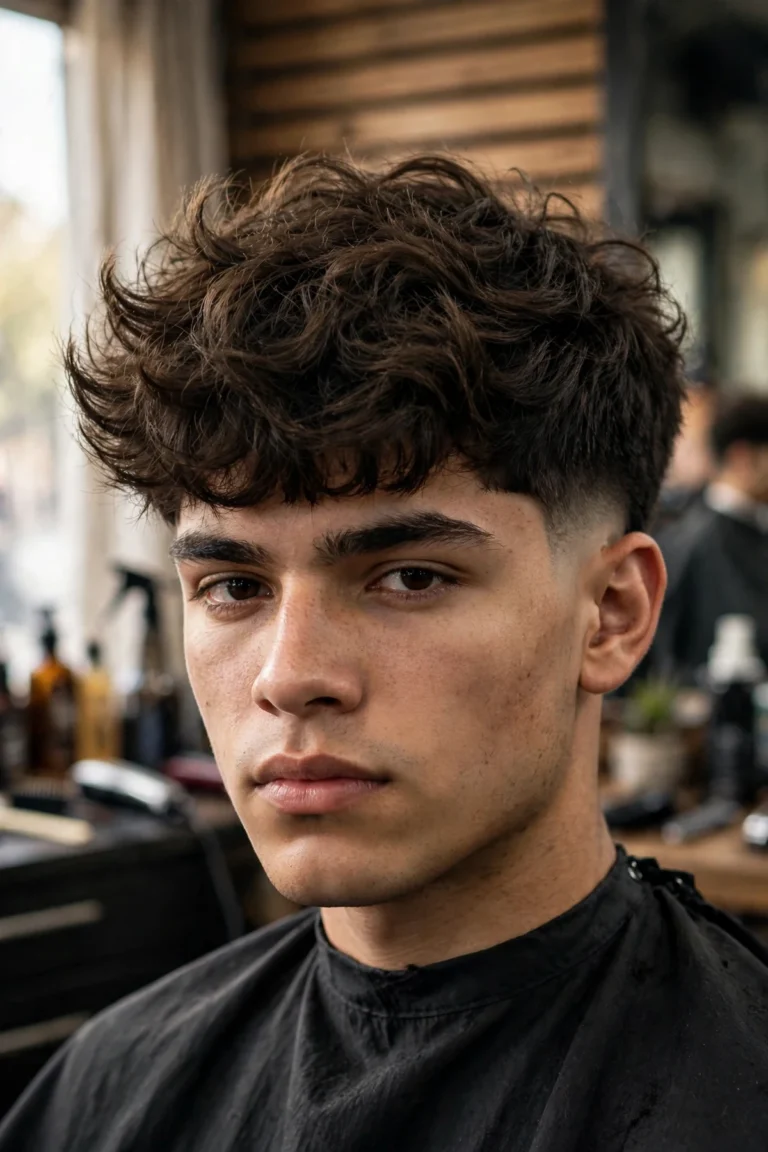
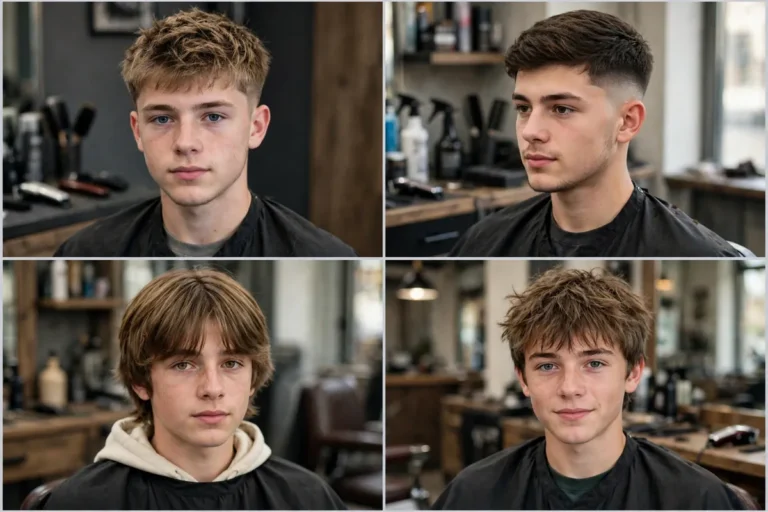
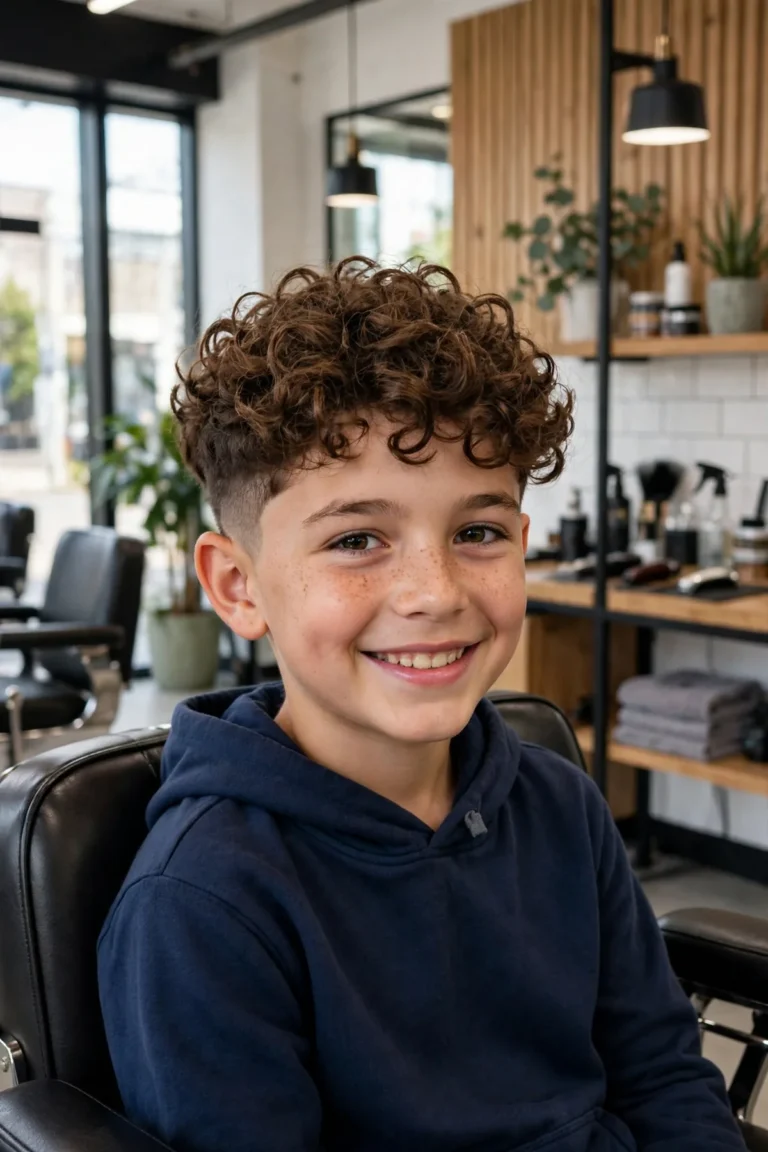
30 Best Blowout Haircuts for Men: The Ultimate Style Guide
There is a reason the blowout haircut keeps showing up everywhere you look right now. Scroll through any barbershop’s feed, walk past a busy chair on a Saturday morning, or glance around a packed subway car, and you will spot it: that full, lifted top with clean, tight sides. It looks expensive. It looks intentional. And here is the best part — it is one of the most versatile men’s hairstyles you can wear today.
But here is what most guys get wrong about the blowout. It is not one single haircut. It is a whole family of blowout hairstyles for men, and the version that looks incredible on your friend might look completely off on you — because hair texture, face shape, and the fade level change everything. Ask for “a blowout” with no specifics, and you are rolling the dice.
This guide fixes that. You will get 30 blowout haircut styles for men, each with the exact words to say to your barber and a quick styling tip so you can recreate the look at home. Then we will cover the full picture: how to blow-dry it yourself in under ten minutes, what it costs, which version suits your face shape and hair type, and the mistakes that quietly ruin the look. By the end, you will know exactly which blowout to ask for — and how to keep it looking sharp between cuts.
What Is a Blowout Haircut?
A blowout haircut is a men’s hairstyle where the hair on top is left medium-length (usually three to five inches) and styled upward and outward with a blow dryer to create volume and height, while the sides and back are cut short with a fade or taper. The name comes straight from the technique: the barber “blows out” the hair with a dryer, lifting it from the roots with a brush, comb, or their fingers.
The contrast is the whole point. Full, airy volume on top. Tight, clean perimeter on the sides. That tension between soft and sharp is what makes the blowout haircut for men so eye-catching — and it is why the style works across so many hair textures. Straight hair gets sculpted lift. Wavy hair gets controlled bounce. Curly and coily hair get a full, rounded crown without losing their natural pattern.
The style has deep roots. In Black barbershop culture, the blowout traces back to the afro blowouts of the 70s, where dryers and picks stretched and shaped natural hair. In Italian-American and Latino barbershops, the “Brooklyn blowout” meant a slicked-back, voluminous top with serious hold. Today’s blowout haircut blends all of that history into something modern: less stiff than the old versions, more textured, and built to look good even on day two.
One thing to understand before you sit in the chair: the cut is only half the equation. With a blowout, the styling technique matters as much as the scissors. Your barber gives you the foundation, but if you do not know how to blow-dry it at home, the look dies the morning after your appointment. That is why this guide spends real time on the at-home routine later — it is the difference between a haircut you love for one day and a hairstyle you love for a month.
Walk into any busy barbershop today and ask about blowout haircuts, and the barber will nod before you finish the sentence. These haircuts for men have moved from trend to staple — the men’s blowout is no longer a niche request but one of the most asked-for styles in the country. Some guys want the full drama of a blowout fade; others prefer the softer grow-out of a taper. Either way, a blowout for men who like volume with structure is hard to beat.
30 Best Blowout Haircut Styles for Men
Every style below comes with a barber script — the exact sentence to use in the chair — plus a styling tip for home. Save the ones you like and show your barber the photos. Words help, but a reference photo closes the deal.
1. The Classic Blowout

This is the original. Three to four inches on top, blown straight up into a full, rounded shape, with a clean taper fading to skin at the temples and nape. It is bold, it is unmistakable, and it photographs like a dream. The classic blowout haircut suits guys who want maximum presence — it genuinely changes the shape of your head in the mirror.
Ask your barber: “Classic blowout. Leave three to four inches on top and blow it straight up for full volume. Taper the sides to skin at the temples and nape, and keep the lineup sharp.”
Style it: Blow-dry upward from the roots on damp hair, then lock it with a medium-hold hairspray. This one needs product to survive the day.
2. Blowout Taper

The blowout taper is the crowd favorite for a reason: it keeps the big volume on top but replaces the aggressive fade with a softer, gradual taper. The sides step down smoothly instead of dropping to skin, so it grows out gracefully and works in offices where a skin fade might raise eyebrows. If you are getting a blowout for the first time, start here — it is the most forgiving version.
Ask your barber: “Blowout with a mid taper. Keep the taper smooth with no harsh lines, leave about three inches on top, and blow it up and slightly back.”
Style it: A volumizing mousse on damp hair before drying gives this version its lift without any crunch.
3. Low Fade Blowout

The low fade blowout starts the fade just above the ears, keeping most of the side length intact. The result is subtle and grown-up — all the volume up top, almost no drama on the sides. It is the easiest blowout to grow out, the cheapest to maintain, and the safest pick if your workplace leans conservative.
Ask your barber: “Blowout with a low fade. Start the fade just above my ears, keep it subtle, and leave plenty of length on top for volume.”
Style it: Because the sides are longer, brush them back neatly while the top goes up — the contrast still reads clearly.
4. High Fade Blowout

Maximum contrast, maximum attention. The high fade blowout takes the fade up above the temples, so nearly all the visual weight sits in the tall, blown-out top. It is dramatic, it is confident, and it is not trying to be subtle. This is the version you see on athletes and artists — the haircut that announces itself before you do.
Ask your barber: “High fade blowout. Take the fade above my temples with real contrast, keep at least three inches up top, and give me a sharp lineup.”
Style it: High fades grow out fastest, so book touch-ups every two to three weeks to keep the contrast crisp.
5. Textured Blowout
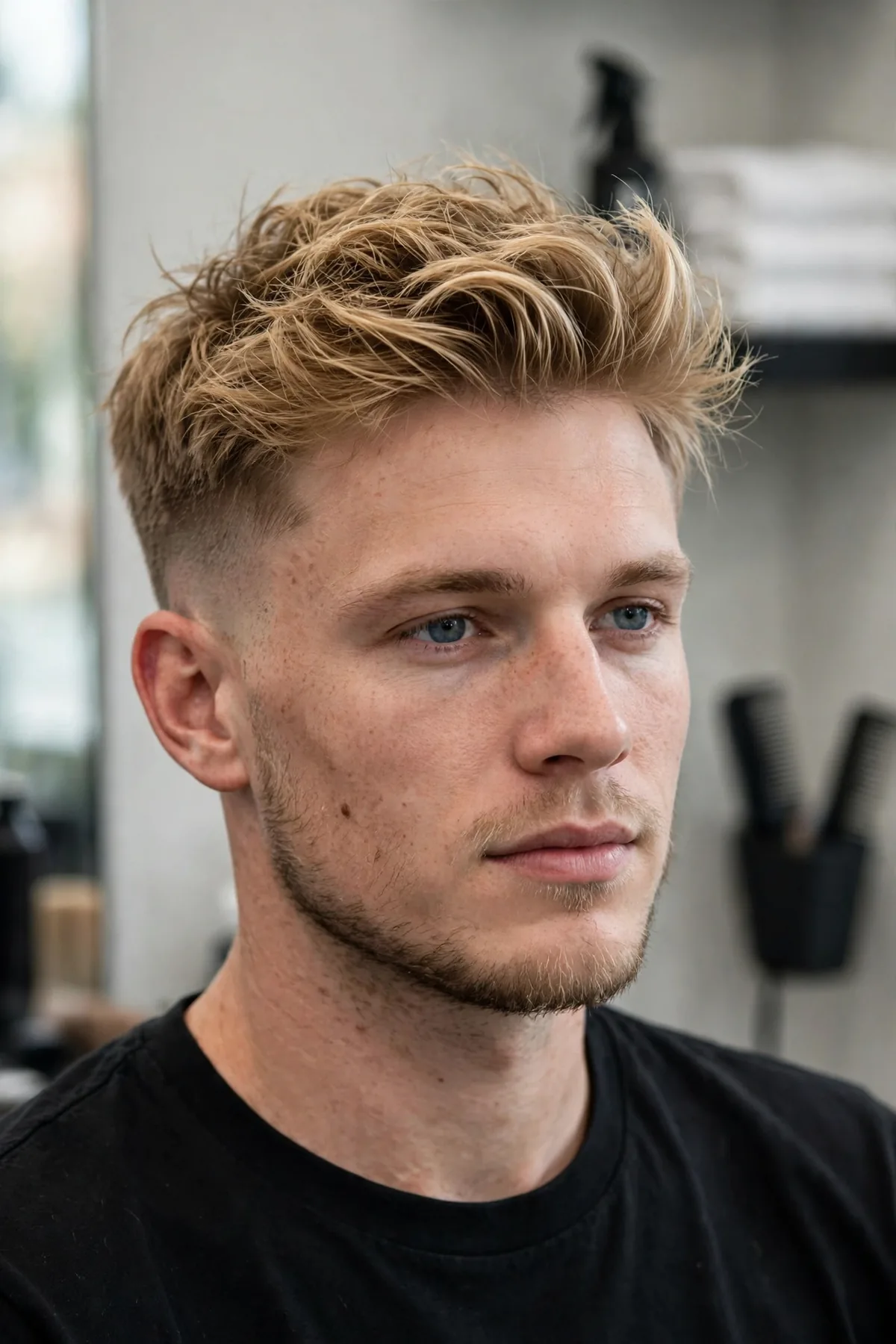
The modern evolution. Instead of one solid sculpted shape, the textured blowout breaks the volume into piecey, separated strands with movement. Your barber uses texturizing scissors to thin and shape the top, then you blow-dry it for lift without the uniform “helmet” look. It reads younger, more relaxed, and it forgives a bad hair day better than any other blowout.
Ask your barber: “Textured blowout. Use texturizing scissors on top for separation, mid fade on the sides. I want movement, not a solid block of volume.”
Style it: Work a matte clay through dry hair with your fingers — never a comb — to keep the pieces separated.
6. Curly Blowout
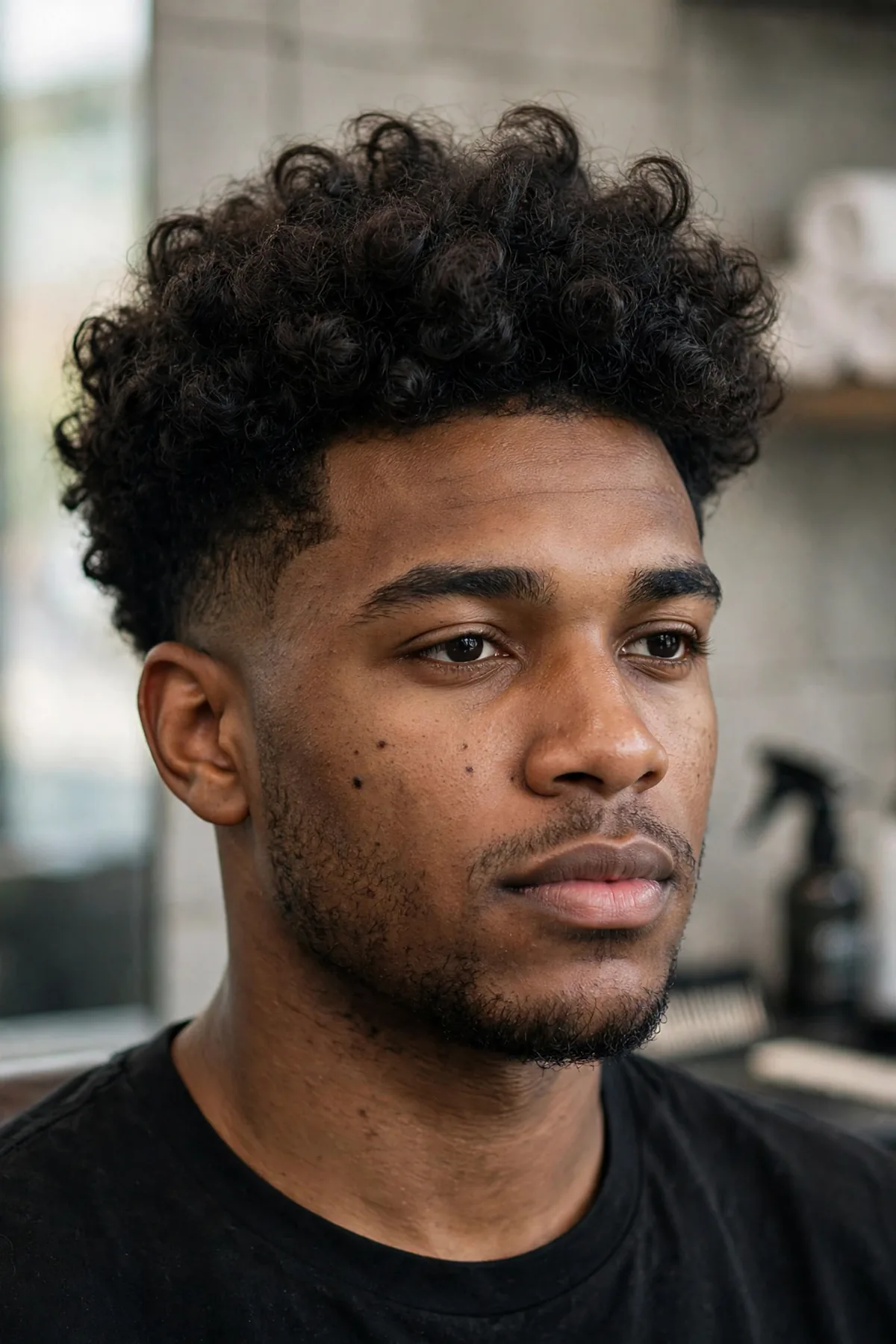
Curly hair and the blowout are a natural match. The curl pattern provides built-in volume, so the dryer just lifts and shapes what is already there. The contrast between defined curls on top and clean faded sides is one of the strongest looks in men’s hair right now. The key instruction for your barber: shape the curls, do not chop them short.
Ask your barber: “Curly blowout. Shape the curls on top but keep at least three and a half inches of length so they have weight to form. Fade the sides.”
Style it: Apply curl cream to damp hair, then diffuse-dry on low heat to protect the curl pattern while adding lift.
7. Afro Blowout

The afro blowout is the fullest expression of the style — a rounded crown of coily hair rising high above a clean taper. It is bold, proud, and rooted in decades of barbershop tradition. A pick is your best friend here: lifting the roots before shaping is what creates that perfect round silhouette instead of a flat top.
Ask your barber: “Afro blowout. Keep the crown full and rounded, taper the sides close following my natural hairline. Shape it with the pick, not clippers, on top.”
Style it: Leave-in conditioner plus a light oil keeps coily blowouts soft and defined. Pick the roots daily to maintain height.
8. South of France Blowout

Sometimes called the gentleman’s mohawk, the South of France blowout concentrates the volume in a wide strip down the center of the head while the sides fade higher than the front and back. The silhouette is wider at the crown and narrower at the temples. It is distinctive without being costume-y — a blowout with a point of view.
Ask your barber: “South of France blowout. Concentrate the volume in a wide strip down the center, fade the sides high to skin, and keep the front and back a touch longer.”
Style it: Dry the center strip upward and slightly toward the middle to emphasize the mohawk-like shape.
9. Temp Fade Blowout

The temp fade (temple fade) sharpens just the temple area into a clean, angular line, while the rest of the sides stay a bit longer than a full fade. Paired with a blown-out top, it frames the face with geometric precision. This is a great pick for guys who want crisp lines without committing to a full high fade.
Ask your barber: “Blowout with a temp fade. Sharpen the temples into clean lines, keep the sides slightly longer, and blow the top up with volume.”
Style it: Keep the temple lines fresh with a trimmer at home every week — the whole look depends on those edges.
10. Messy Blowout
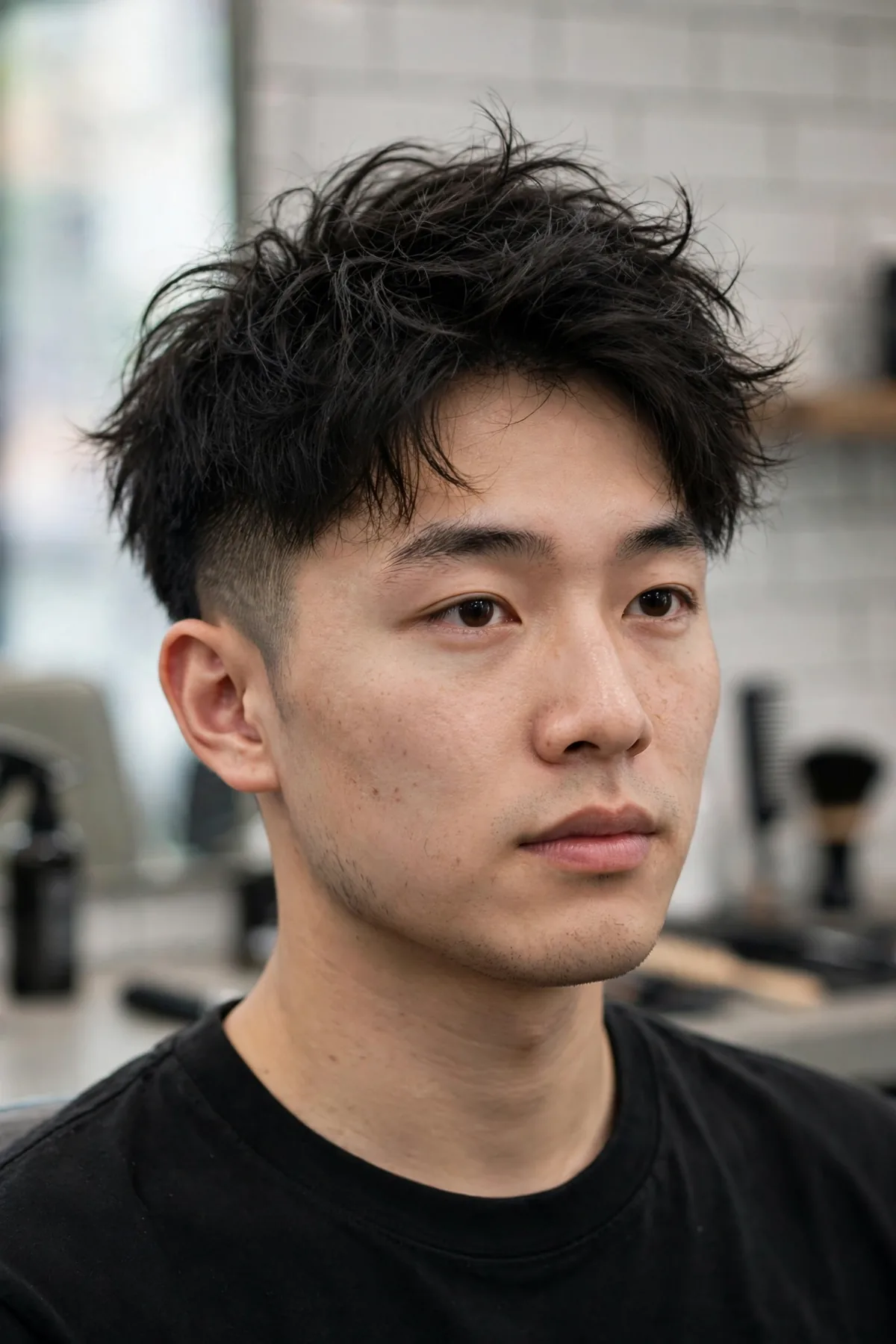
The messy blowout takes the volume and deliberately roughs it up — uneven lift, pieces going in slightly different directions, zero stiffness. It looks like you woke up with great hair, which is exactly the point. This is the lowest-maintenance blowout on the list because imperfection is the design.
Ask your barber: “Messy blowout. Keep the top choppy with uneven texture, mid fade on the sides. I want it to look effortless, not sculpted.”
Style it: Sea salt spray on damp hair, rough-dry with your fingers pointing in different directions, and stop before it looks “done.”
11. Slicked-Back Blowout

The boardroom blowout. All the volume sweeps straight back instead of up, giving you height and presence with a polished finish. It is the most office-friendly blowout variation — it reads as a power haircut, not a statement one. A touch of sheen in the product keeps it refined rather than matte-casual.
Ask your barber: “Slicked-back blowout. Keep four inches on top to sweep back, low taper on the sides, and a natural hairline — nothing too sharp.”
Style it: Blow-dry straight back with a vent brush, then smooth a pea-sized amount of light pomade over the top for control with shine.
12. Side Part Blowout

A defined side part grounds the blowout’s volume in something classic. The part gives the style direction and structure, which makes it a smart choice for guys with strong cowlicks — the part works with the growth pattern instead of fighting it. Think modern classic: volume with manners.
Ask your barber: “Blowout with a side part. Cut the part in cleanly, keep three to four inches on top, mid fade on the sides.”
Style it: Set the part while hair is damp, then blow-dry each side away from the part line to lock the direction in.
13. Blowout with Textured Fringe
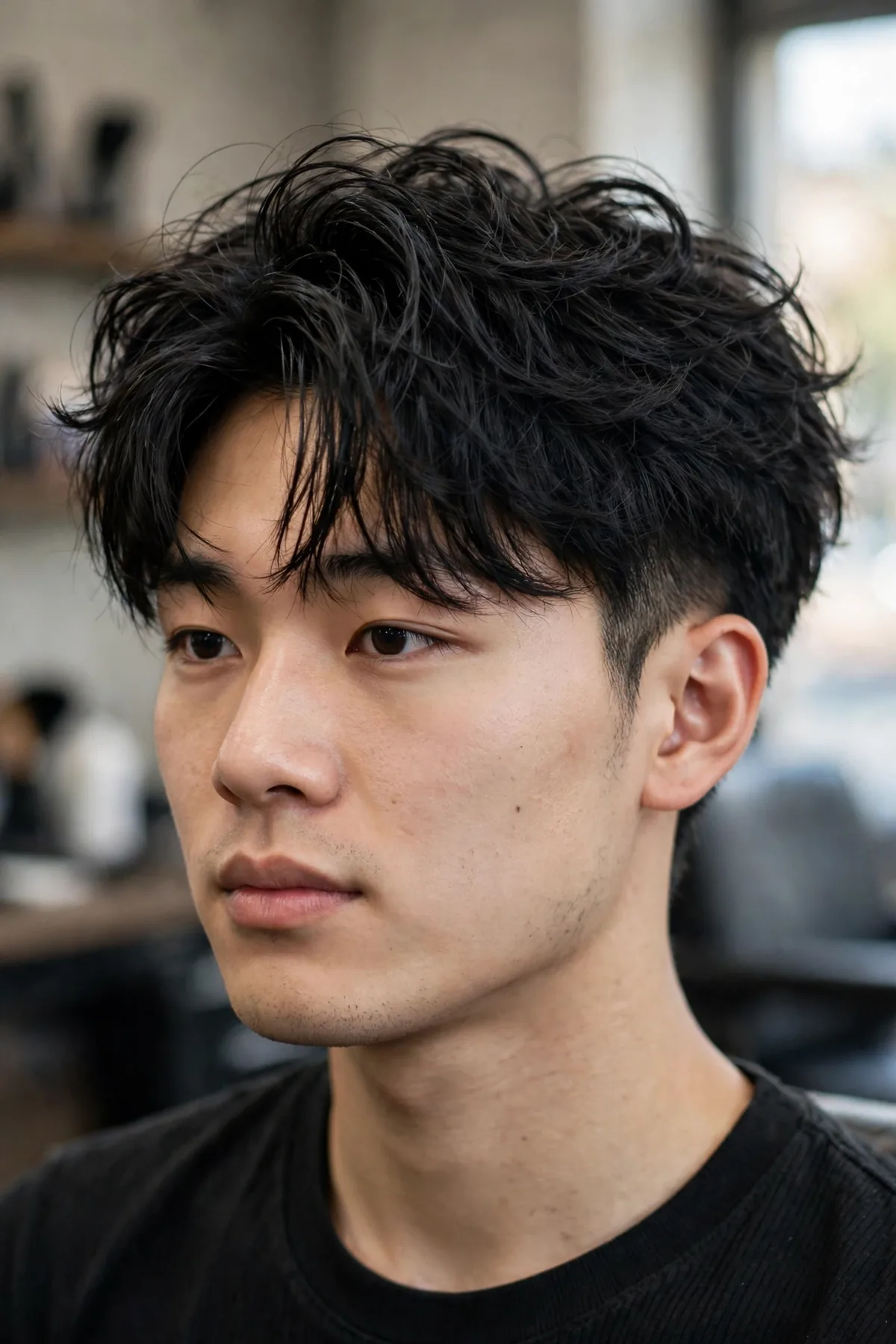
Volume on top, fringe on the forehead. This is the most requested blowout variation among younger guys right now: the crown goes up and back while a piecey fringe falls forward over the forehead. It frames the face, softens a high forehead, and looks good from every angle — which is why it dominates barbershop feeds.
Ask your barber: “Blowout with a textured fringe. Blow the crown up for volume but leave the front long enough to fall forward as a piecey fringe. Low taper on the sides.”
Style it: Dry the crown upward first, then pull the fringe forward with a round brush and finish with matte paste for separation.
14. Blowout Mullet

The blowout mullet keeps the big lifted volume on top and in front, fades the sides, and lets the back grow long. Business in the front takes on a whole new meaning when the front is a towering blowout. It is a statement haircut — not for the cautious — but on the right guy it is unforgettable.
Ask your barber: “Blowout mullet. Big volume on top and front, faded sides, and leave the back long — at least past the collar. Blend the top into the length.”
Style it: The back needs different treatment than the top: blow the top up, smooth the back down with a brush, and use separate products for each.
15. Short Blowout
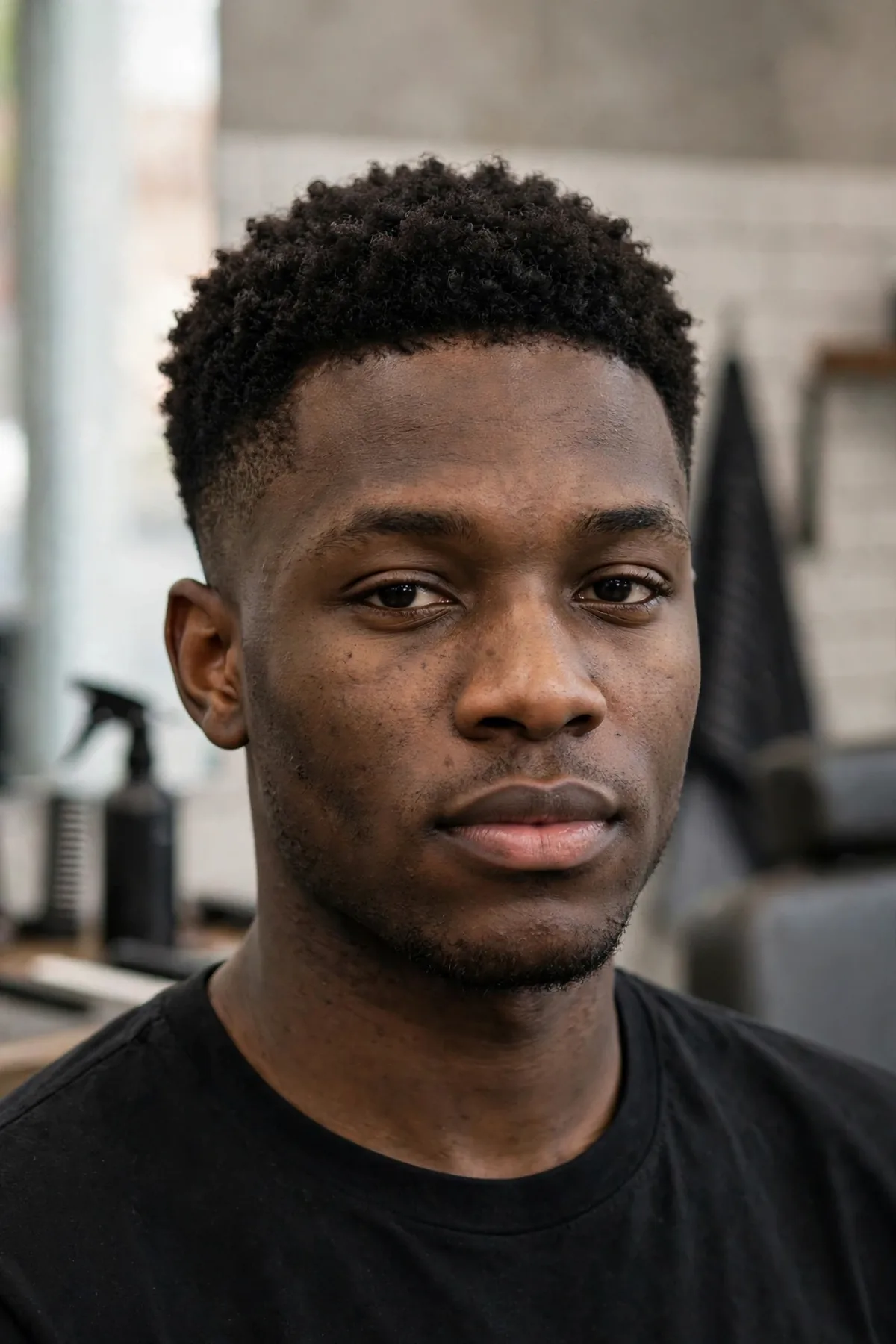
Not everyone wants four inches of hair standing up. The short blowout keeps the top around two inches — just enough to lift — with a clean taper. It hints at the blowout shape without the daily styling commitment. Perfect for athletes, guys in hard hats, or anyone who wants the vibe in five minutes flat.
Ask your barber: “Short blowout. Keep the top around two inches with enough length to lift, low taper on the sides. Keep it neat and low-maintenance.”
Style it: A quick blast with the dryer on high heat for 60 seconds plus a dab of matte clay — that is the whole routine.
16. Long Blowout
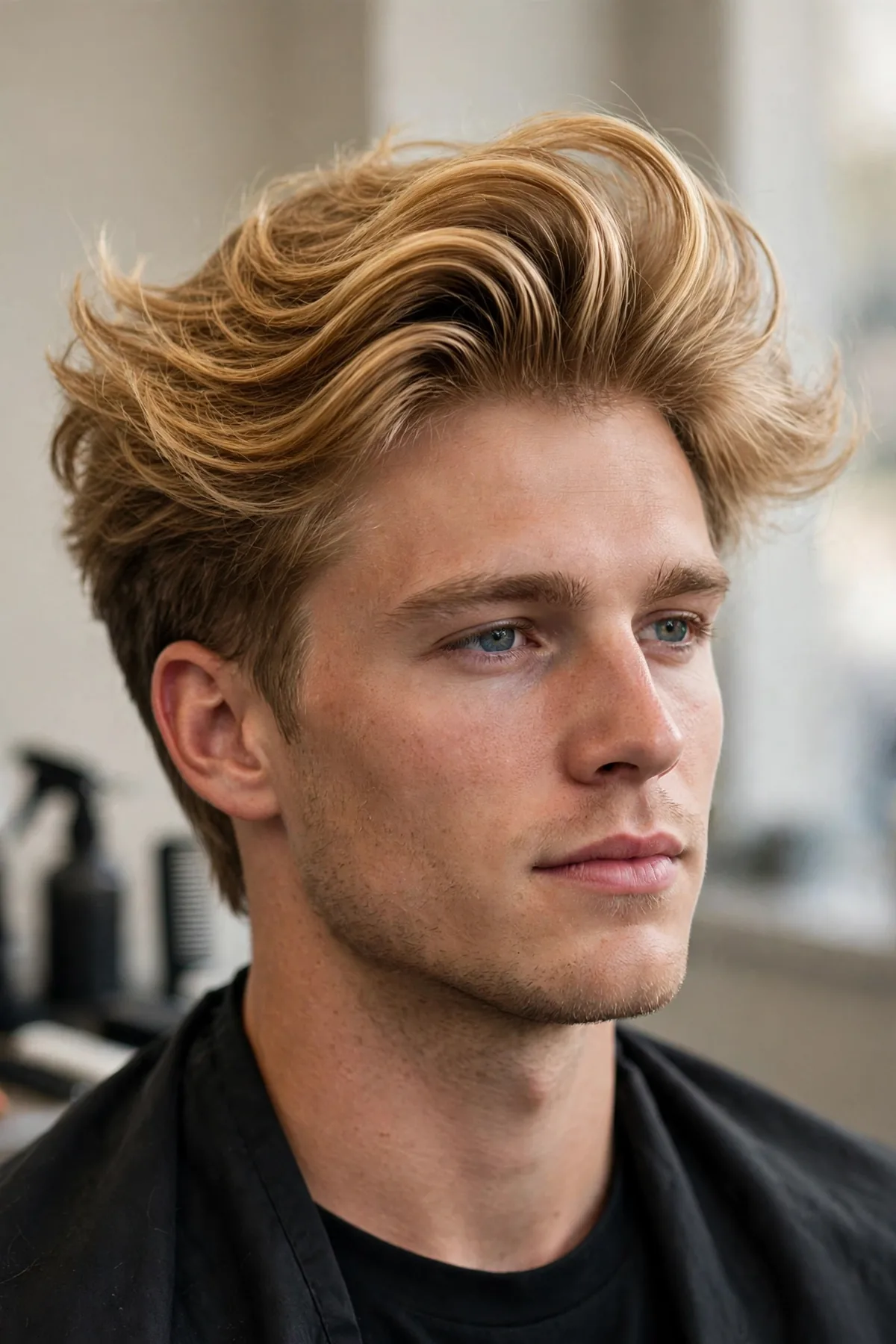
When the top stretches to five or six inches, the blowout becomes dramatic — height at the roots, movement in the lengths, real presence. This version needs healthy hair and a little patience, because long hair takes longer to dry and style. The payoff is a look nobody else in the room is wearing.
Ask your barber: “Long blowout. Keep five to six inches on top with long layers for movement, tapered sides. Thin the ends slightly so it is not too heavy.”
Style it: Section the hair and dry it in layers — roots first, then mid-lengths. Trying to dry it all at once just creates frizz.
17. Blowout Edgar

The edgar meets the blowout: a heavy, blunt, straight-across fringe combined with serious volume on top and faded sides. It is bold, it is polarizing, and it has a massive following. The blunt fringe is the star — it needs to be cut dead straight, so this is not the haircut to cheap out on.
Ask your barber: “Blowout edgar. Cut the fringe blunt and straight across, keep the top voluminous, and fade the sides clean.”
Style it: Flat-iron the fringe section after blow-drying so it sits perfectly straight — the crisp line is the whole look.
18. Wavy Blowout

Wavy hair might be the easiest hair type for a blowout. The natural bend does half the work — you just lift and shape it. The result is controlled bounce with organic movement that straight hair cannot fake. Two and a half to three inches is plenty of length; wavy hair does not need more to look full.
Ask your barber: “Wavy blowout. Keep two and a half to three inches on top with light layers, mid taper on the sides. Enhance the wave, do not fight it.”
Style it: Sea salt spray plus a diffuser on low heat enhances the wave pattern while adding lift. Some days you can even skip the dryer entirely.
19. Straight Blowout

Straight hair is the hardest texture for a blowout because it has no natural body — every bit of volume comes from technique and product. But when it is done right, the straight blowout is the cleanest, most sculpted version of the style: sharp lines, deliberate shape, architectural. It looks precision-engineered because it is.
Ask your barber: “Straight blowout. Keep three and a half to four inches on top with light layers for movement, mid fade on the sides.”
Style it: Volumizing mousse is non-negotiable for straight hair, plus a round brush while drying. Finish with strong-hold hairspray or it collapses by lunch.
20. Blowout Pompadour

The pompadour’s height meets the blowout’s airiness. The front sweeps up tall and back in that classic pomp shape, but the blow-dry technique keeps it lighter and more textured than the old greased versions. It is vintage and modern at the same time — a haircut with history that still turns heads today.
Ask your barber: “Blowout pompadour. Keep the front long — four to five inches — to sweep up, shorter toward the crown, low fade on the sides.”
Style it: Dry the front up and back with a round brush, rolling it under slightly at the ends to build the pomp roll. Medium-hold pomade keeps it in place.
21. Blowout Quiff

The quiff’s signature flick gets the blowout treatment: the front lifts high and brushes back with real volume instead of sitting flat. It is a natural pairing — both styles are built on height at the front. If you already wear a quiff haircut, this is your upgrade path.
Ask your barber: “Blowout quiff. Keep the front long to lift and flick back, textured top, mid fade on the sides.”
Style it: Dry the front upward first with a round brush, then push it back and slightly to one side. A matte paste holds the flick without stiffness.
22. Blowout with a Beard

Volume on top, weight on the jawline — the blowout-beard combo balances the face from both ends. The fullness up top keeps a heavy beard from dragging your look down, and the clean faded sides create a crisp border between hair and beard. It is one of the most masculine pairings in men’s grooming right now.
Ask your barber: “Blowout with a beard trim. Big volume on top, mid fade on the sides, and shape the beard to connect cleanly with the sideburns.”
Style it: Keep the beard lines sharp — a fuzzy neckline will undo all the crispness the blowout creates. Line it up weekly.
23. Blowout with Line Design

A crisp shaved line (or two) etched into the faded sides turns the blowout into wearable art. The design lives in the fade, so it is temporary by nature — it grows out in a couple of weeks, which means you can experiment without commitment. Keep the top classic and let the sides do the talking.
Ask your barber: “Blowout with a line design. Classic volume on top, skin fade on the sides, and etch one clean line design into the fade.”
Style it: Designs blur as hair grows, so book a two-week touch-up if you want the art to stay sharp.
24. Blowout Curtains

Curtains meet the blowout: a middle part with voluminous, face-framing length on both sides, lifted at the roots with the dryer. It softens the blowout’s boldness into something more romantic and wearable. Guys with symmetrical features wear this one best — the center part puts your face on full display.
Ask your barber: “Blowout curtains. Middle part, four inches on top with curtain length framing the face, low taper on the sides.”
Style it: Dry each side away from the center part with a round brush to build the curtain sweep. Light cream keeps it soft, not crunchy.
25. Blowout Wolf Cut

The wolf cut’s shaggy layers get blown out for volume and paired with clean tapered sides. It is the edgiest blowout on this list — choppy, textured, deliberately wild on top while the perimeter stays sharp. Not for the office, perfect for the weekend.
Ask your barber: “Blowout wolf cut. Heavy layers on top for that shaggy texture, blow it out for volume, and keep the sides tapered clean.”
Style it: Texture powder at the roots adds grit and lift. Scrunch the ends while drying to emphasize the choppy layers.
26. Blowout with Highlights

A few subtle highlighted strands through the blown-out top catch the light and add dimension that a single color cannot. The volume gives the highlights room to show — every angle reveals a different strand. Keep it to one or two shades lighter than your base; this is about depth, not drama.
Ask your barber: “Blowout with subtle highlights. Big volume on top, mid fade on the sides — and add a few face-framing highlights one or two shades lighter.”
Style it: Highlights dry out faster than virgin hair, so use a heat protectant every time you blow-dry. Non-negotiable.
27. Fine-Hair Blowout

Thin or fine hair can absolutely wear a blowout — it just needs a lighter touch. The goal is airy lift, not heavy height. Your barber should keep the layers soft (no harsh thinning that removes what little density you have), and the styling relies on mousse and root-lifting technique rather than piling on product.
Ask your barber: “Blowout for fine hair. Keep soft layers — do not thin it out aggressively — and leave enough length on top for lift. Low taper on the sides.”
Style it: Flip your head upside down for the first 60 seconds of drying. Gravity is the best volumizer fine hair has, and it is free.
28. Thick-Hair Blowout
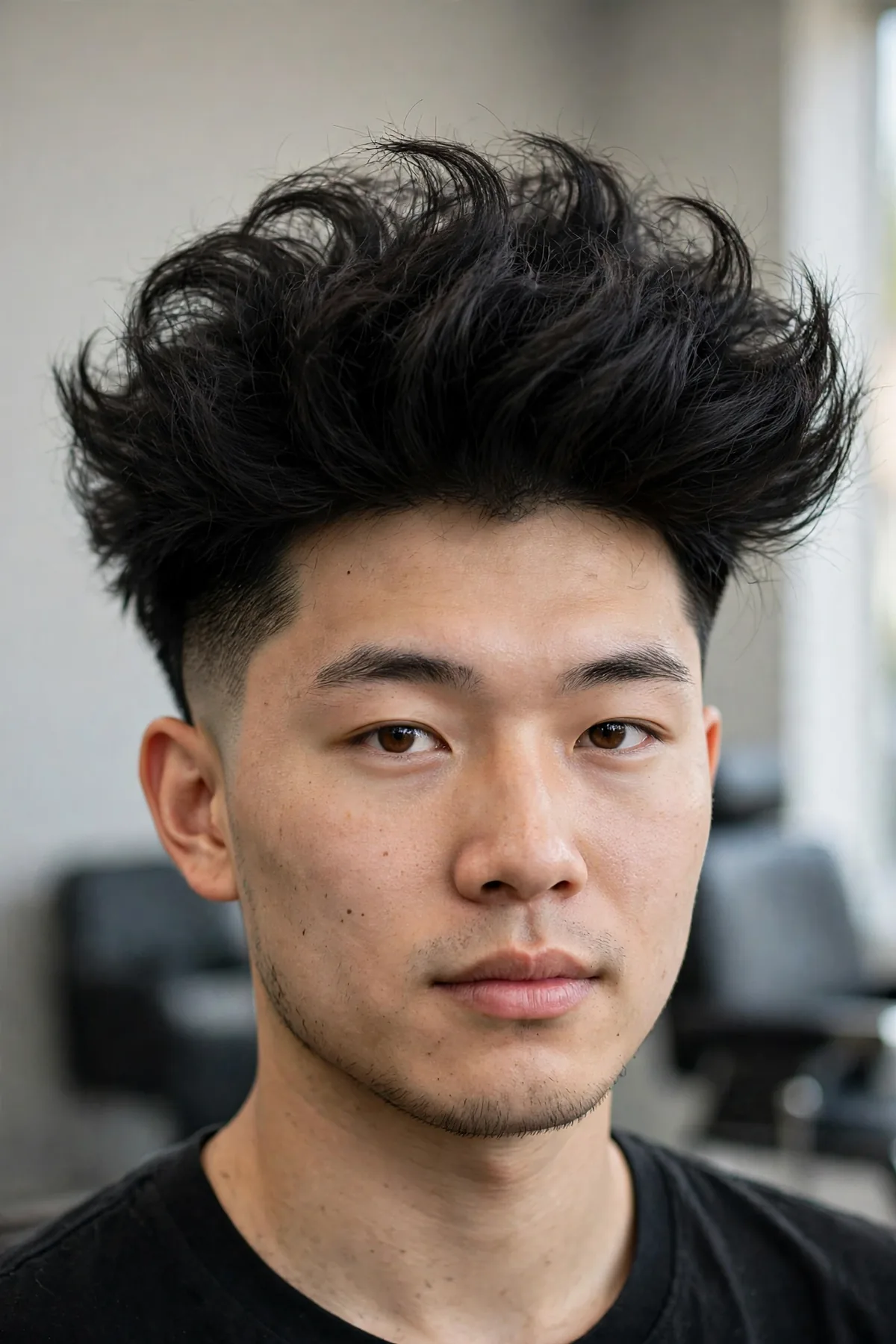
Thick hair was born for the blowout — the density creates volume almost automatically. The challenge is control: without thinning and shaping, thick hair blows out into a shapeless mass. Ask your barber to remove weight with thinning shears through the interior, keeping the length but reducing the bulk.
Ask your barber: “Blowout for thick hair. Thin the interior to remove weight but keep the length, blow it out for controlled volume, mid fade on the sides.”
Style it: A smoothing cream before drying tames frizz, and a vent brush (not a round brush) gives you control without adding more volume than you need.
29. Spiky Blowout

The blowout goes punk. Instead of one smooth shape, the top is worked into defined, lifted spikes with real texture. It keeps the blowout’s height but trades polish for attitude. This is a night-out haircut — bold, high-energy, and impossible to ignore.
Ask your barber: “Spiky blowout. Keep the top choppy with texture, skin fade on the sides. I will spike it up myself — just give me the right lengths.”
Style it: Blow-dry upward first for the base volume, then pinch small sections with a strong matte wax to form the spikes. Work from back to front.
30. Blowout with Drop Fade

The drop fade curves down behind the ears instead of cutting straight across, following the natural shape of the head. Under a blown-out top, it creates a smooth, rounded transition that looks custom-fitted. It is a subtle detail that barbers love and most guys have never heard of — which makes it a great “in the know” pick.
Ask your barber: “Blowout with a drop fade. Let the fade drop behind my ears following my head shape, keep the top full and voluminous.”
Style it: The drop fade’s curve shows best when the hair above it is clean — keep the transition area product-free so the blend stays visible.
How to Blow-Dry a Blowout at Home (Under 10 Minutes)
Here is the truth most guides skip: your barber’s blowout looks perfect because they have done it ten thousand times. Yours will look great too once you learn the sequence. It takes under ten minutes with practice. You will need a hair dryer with a nozzle attachment and a cool-shot button — that is the entire equipment list that actually matters.
- Start with damp, not wet, hair. Towel-dry until your hair stops dripping but still feels cool to the touch. Soaking wet hair takes forever to dry and falls flat; dry hair cannot be reshaped. Damp is the sweet spot.
- Apply your base product now. Volumizing mousse for straight or fine hair, sea salt spray for wavy hair, curl cream for curly or coily hair. Work it through the top with your fingers. Do not touch the faded sides.
- Attach the nozzle and use medium heat. The nozzle concentrates airflow, which is what creates lift instead of frizz. High heat damages hair over time — medium heat with patience wins.
- Dry upward from underneath. Point the dryer up from below your hairline, pushing the hair upward and slightly back with your fingers or a round brush. Work from the back of the head forward, section by section. This is the move that creates the “blown out” volume.
- Lift at the roots, not the ends. Spend most of your time at the root area — five to ten seconds of directed air per section. The ends will dry on their own. Volume lives at the roots.
- Hit the cool shot for 30 seconds. Switch to cool air and go over the whole top once. Cool air locks in the shape that warm air created. Skip this step and your volume collapses by midday — this is the most-skipped step in home blowouts.
- Apply finishing product with your fingers. Pea-sized amount of matte clay or texture paste, rubbed between your palms and pressed into the top. Do not comb it through — combs flatten everything you just built.
- Shape, do not fuss. Push the hair up and slightly back with your fingers. Then stop. The more you touch it after styling, the faster it falls.
The number one home mistake: trying to style hair that is already dry. The shaping happens while hair transitions from damp to dry — that is the only window when it can be molded. If your hair dried before you started, mist it lightly with water and begin again.
Your Blowout Equipment Checklist
You do not need a professional kit, but the right tools make the difference between a five-minute routine and a twenty-minute struggle. Here is what actually matters:
- Hair dryer (1800+ watts) with a nozzle concentrator and a cool-shot button. The nozzle is non-negotiable — without it, you are just making frizz.
- Round brush (medium barrel for most hair; large barrel for long tops) — for straight and wavy hair. Creates the bend and lift that fingers alone cannot.
- Vent brush — for thick hair. Moves air through dense hair faster without adding extra volume you do not need.
- Diffuser attachment — for curly and wavy hair. Spreads airflow so curls keep their pattern while gaining lift.
- Pick comb — for coily hair. Lifts roots and shapes the crown without disturbing the coil pattern.
- Volumizing mousse — the foundation product for straight and fine hair. Apply to damp hair before drying.
- Matte clay or texture paste — the finishing product for almost every blowout. Hold without shine.
- Heat protectant spray — if you blow-dry daily, this protects your hair from cumulative heat damage. Especially important for highlighted or color-treated hair.
- Light-hold hairspray — optional, for humid climates or long days. One light mist from 12 inches away.
Blowout Haircut by Hair Type
The same blowout behaves completely differently depending on your texture. Here is the honest breakdown:
Straight hair is the trickiest — it has no natural body, so all volume comes from technique and product. Ask for extra length on top (three and a half to four inches) and light layers. Mousse before drying and hairspray after are mandatory, not optional. Some guys with very straight hair get a light perm to make the shape hold all day.
Wavy hair is the easiest. The natural movement plays perfectly with the blowout shape, and two and a half to three inches is plenty. Sea salt spray and a diffuser enhance what is already there. Many wavy-haired guys can skip the full routine on lazy days and still look good.
Curly hair creates stunning blowouts — defined curls on top against clean faded sides is a high-impact look. The instruction that matters: tell your barber to shape, not shorten. Curls need weight (at least three and a half inches) to form properly. Curl cream on damp hair plus diffuse-drying protects the pattern.
Coily hair turns the blowout into a true crown — the fullest, tallest version of the style. The taper creates clean definition where hair meets skin. Leave-in conditioner, a curl sponge for shape, and a pick to lift the roots are the core routine. This texture holds a blowout shape longer than any other between washes.
Which Blowout Suits Your Face Shape?
The blowout adds height and width to the top of your head, and that geometry flatters different faces differently. Quick cheat sheet:
- Oval: You are lucky — every blowout variation works. The mid blowout taper is the safe default.
- Round: Add vertical height to elongate the face. Go for the classic blowout or South of France, and avoid wide, round volume that emphasizes width.
- Square: Soften the strong jawline with a blowout taper or textured blowout. Skip extremely angular high fades.
- Oblong/long: Keep top volume moderate — too much height makes a long face look longer. A low fade blowout is your friend.
- Diamond: Volume on top balances a narrow forehead and chin. Mid fade or temp fade blowout keeps everything proportional.
- Heart: Volume adds balance to a narrower chin. Temp fade or textured blowout works well; avoid extremely high, wide volume.
The universal rule: if your face is wider than it is long, add height. If it is longer than it is wide, moderate the height. Every blowout on this list is adjustable — tell your barber your face shape and let them tune the volume.
What Does a Blowout Haircut Cost?
A blowout haircut typically costs between $30 and $60 at most American barbershops, with the national average sitting around $40 to $45. Big-city shops and high-end barbers charge $60 to $80, while smaller towns often land in the $25 to $35 range. The price depends on the shop, the city, and how much detailing the cut needs — a blowout with a line design or a razor-sharp lineup costs more than a basic taper version.
Budget for the real cost, not just the chair price. A blowout needs a touch-up every three to four weeks to stay sharp (every two weeks for high fades), plus a volumizing mousse ($10–$15) and a matte clay ($12–$20) that last a couple of months each. All in, expect roughly $50 to $70 a month to keep a blowout looking its best. Tip your barber 20% — a good blowout is skilled work, and barbers remember who tips well.
7 Mistakes That Ruin a Blowout
- Asking for “a blowout” with no specifics. That phrase means ten different things to ten different barbers. Specify the variation, the fade level, and the top length — or better, bring a photo.
- Cutting the top too short. You need a minimum of three inches on top for a real blowout. Anything shorter cannot be blown upward properly, and no amount of product fixes it.
- Using shiny pomades or heavy gels. The modern blowout is a matte, textured look. High-shine products weigh it down and make it look dated. Matte clay or texture paste only.
- Blow-drying hair that is already dry. Styling happens in the damp-to-dry window. Dry hair cannot be reshaped — mist it and start over.
- Skipping the cool-air step. Thirty seconds of cool air locks in the volume. Without it, everything you built collapses within hours.
- Shaping with a comb instead of fingers. Combs flatten texture and kill the piecey separation that makes a blowout look modern. Fingers only.
- Waiting too long between cuts. The blowout looks worst between weeks five and seven, when the fade has grown out but the top is still long. Book every three to four weeks and the style never has an awkward phase.
Blowout Haircut FAQs
How long does a blowout haircut last?
A blowout haircut stays sharp for three to four weeks. The faded or tapered sides grow out first — high fades need a touch-up around week two, while tapers hold their shape closer to week four. The top stays workable for five to six weeks, but the contrast that makes the style pop fades after a month. Book your next cut at week three and you will never have an awkward grow-out phase.
Can I get a blowout haircut with thin or fine hair?
Yes — with the right approach. Fine hair needs a lighter touch: soft layers instead of aggressive thinning, volumizing mousse on damp hair, and root-lifting technique (try flipping your head upside down for the first minute of drying). Keep the volume airy rather than tall. Avoid heavy products that weigh fine hair down, and skip high-shine pomades entirely.
What is the difference between a blowout and a blowout taper?
A blowout is the overall style family — voluminous top styled with a dryer. A blowout taper is one specific variation where the sides graduate down smoothly with a taper instead of dropping to skin with a fade — it is the blowout haircut men ask for most often at the chair. The taper version is softer, grows out more gracefully, and suits conservative settings. Think of “blowout” as the category and “blowout taper” as its most popular member. Our taper fade guide breaks down the taper side in detail.
How do I ask my barber for a blowout haircut?
Use this script: “I want a [variation] blowout. Leave the top at [length] inches and blow-dry it up for volume. I want a [high/mid/low] fade on the sides. For the lineup, I want it [sharp and angular/natural and soft].” Then show two or three reference photos of someone with a similar hair texture to yours. The photo matters more than the words — bring one.
Is the blowout haircut good for curly hair?
It is one of the best haircuts for curly hair. Curls provide natural volume, so the style practically builds itself — the dryer just lifts and shapes. Keep at least three and a half inches on top so curls have weight to form, tell your barber to shape rather than shorten, and use curl cream with a diffuser. The contrast between defined curls and clean faded sides is a standout look.
What products do I need for a blowout haircut?
Three essentials cover most guys: a volumizing mousse applied to damp hair before drying (the foundation), a matte clay or texture paste for finishing (the hold), and a heat protectant if you blow-dry daily. Add sea salt spray for wavy hair, curl cream for curly or coily hair, and a light-hold hairspray for humid climates. That is the complete kit — anything more is optional.
The Bottom Line
The blowout haircut earns its popularity. Few men’s hairstyles deliver this much impact — the volume, the contrast, the way it frames your face — while working across nearly every hair texture and face shape. The secret is specificity: pick your variation from the 30 above, learn the ten-minute at-home routine, and use the barber script that matches. Do that, and the blowout stops being a haircut you get once and becomes a hairstyle you actually live in.
Ready for more ideas? Browse our mens haircuts guide for the full library of styles, check the fade haircut breakdown to pick your fade level, or explore mid fade, low taper fade, and messy hairstyles for men for more volume-driven looks.